Most vintage toy shops sell memory. The sharper ones also sell suspicion. That’s the feeling hanging over That’s My Collectible in Bernardsville, New Jersey, where familiar cars, figures, and boxed relics can flip from harmless nostalgia to potential collector bait the moment you start wondering what version you’re actually looking at.
That’s My Collectible is not pretending to be a generic gift shop. Its site pitches iconic toys from the 1970s through the 1990s, spotlights lines like Star Wars, Teenage Mutant Ninja Turtles, Transformers, He-Man, Marvel, and Back to the Future, and even offers a mystery “CollectiBag” stuffed with retro surprises. Founder Tim Manning says the business grew from an Instagram collecting journey in 2021 into a Bernardsville pop-up in late 2023, then a mobile vintage toy store in 2024, before landing in a permanent Quimby Lane storefront.
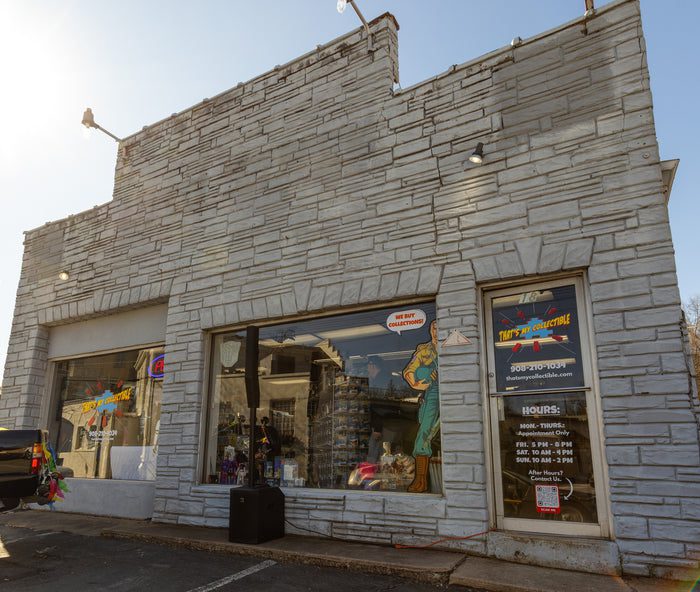
That origin story matters because collector-run shops train your eye differently. A casual shopper sees an old toy. A collector sees condition, accessories, packaging, and the tiny line-specific quirks that can turn something ordinary into something hunted. When a store specializes in franchises people never stopped loving, every shelf carries a little extra charge. You are not just browsing old playthings. You are browsing categories with real secondary markets attached to them.
Star Wars is a clean example of how fast the tone can change. In March 2025, Hake’s sold a 1979 Boba Fett 21 Back-B figure for $4,783.13. That is not some one-of-one museum oddity. It is a familiar character from a familiar toy line, just in a preserved and collectible form that serious buyers cared about. Suddenly the distance between “old action figure” and “expensive collectible” does not look very wide.

He-Man works the same way. In May 2025, a graded 1987 Scare Glow sold at Hake’s for $5,310.00. On the same May auction block, a graded 1988 TMNT Foot Soldier brought $716.26. Those numbers matter less as bragging rights than as context. They explain why a shop full of turtles, muscle-bound warriors, and other Saturday-morning survivors can feel a little more electric than it first appears. The toys themselves are familiar. The market built around the best examples is what catches people off guard.
Even the car section can do it. Heritage sold a 1969 Hot Wheels Redline Drag’ Chute Stunt Set for $1,093.75 in November 2024, and Hake’s sold a Hot Wheels Redline Hot Heap on card for $289.10. Those are not throwaway numbers. They are big enough to force a second look at the kind of item many people still file under “old toy box stuff.” That is the real surprise inside a place like That’s My Collectible: the same object can read as childhood clutter to one person and as a very specific find to another.

The caveat is the part clickbait usually skips. Auction-level prices usually belong to toys that are graded, carded, unusually clean, or complete with the tiny accessories most kids lost decades ago. A loose figure with worn paint is not the same market object as a sealed or carefully preserved one. But that does not kill the thrill. It sharpens it. Suddenly details matter: the bubble, the file card, the weapon, the stamp on the chassis, the version nobody notices until a collector points it out.
That tension is what makes a good nostalgia shop sticky. Manning frames That’s My Collectible around rediscovering the toys that made growing up unforgettable, and that emotional pull is obviously real. But places like this also feed a second instinct: the urge to inspect. One shopper is chasing a memory. Another is quietly checking whether the piece in front of them is complete, early, odd, or scarce enough to matter. The same shelf can serve both people at once.

So the headline is not wrong, even if the bigger surprise is not a single magic toy hiding in plain sight. It is the realization that a New Jersey collectibles shop can make you look at ordinary old plastic differently. Most of the time, you are just holding a cool piece of childhood. Every so often, though, you are holding something that the collector world has already taught itself to value much more aggressively than common sense would predict.