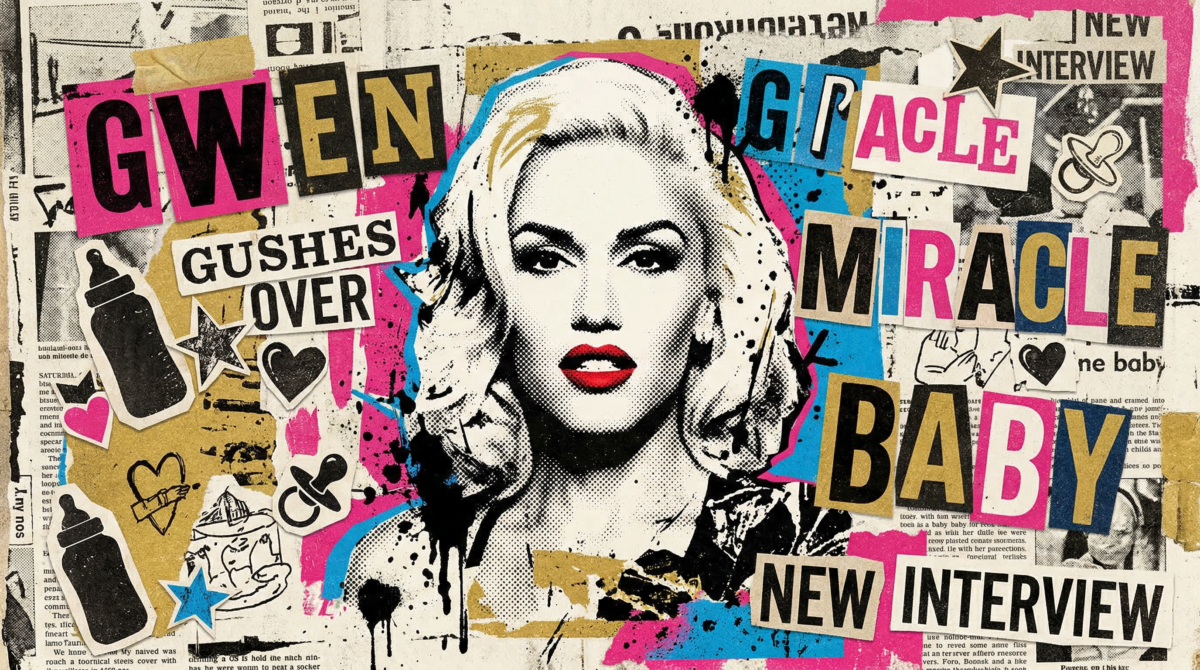
A Voice, a Prayer, and a Baby Named Apollo
There is a version of Gwen Stefani the world has memorized: the platinum-streaked frontwoman of No Doubt, the ska-punk girl from Anaheim who made flannel and bindis and fishnet stockings feel like a personal manifesto. The woman who turned heartbreak into stadium anthems. But sit with her long enough — or, as it turns out, listen to her on a Catholic prayer app during Lent — and a different portrait emerges. One that has been there all along, just quieter than the bass line.
In a conversation released as part of Hallow’s 2026 Lent prayer challenge, Stefani sat down with biblical scholar and theologian Jeff Cavins for the kind of interview that doesn’t show up on morning television. No one asked about her fashion line. No one brought up Blake Shelton’s last album. Instead, they talked about her grandfather going to daily Mass, about a child’s prayer answered in ways that defied medicine, about what it feels like to stand in the wings of a packed arena and want — desperately, privately — for God to use you.
Stefani announced her participation in the challenge on February 18, 2026, via Instagram. The response was immediate and electric. For millions of Catholics who grew up on “Don’t Speak” and “Just a Girl,” the revelation landed somewhere between surprising and completely obvious.
Roots in Anaheim
Faith, for Stefani, is not a late-life discovery or a celebrity reinvention. It is architecture. The foundation was poured early, in a household in Orange County where the rhythms of the Catholic Church structured the week like a second calendar.
Her grandfather was the kind of Catholic that most people only read about — at Mass every single day, not out of obligation but out of something closer to need. That image stayed with her. Her mother seeded belief in the particular way that mothers do, not through argument but through proximity, through the quiet insistence of evening prayers and Sunday pews. The faith was ambient before it was chosen. It was the water before it was the swim.

And like most things absorbed in childhood, it receded at times. Fame does that. A career that began in garages and ended in arenas does not leave much room for contemplation. But the faith never disappeared entirely. It waited.
“I’m a baby Christian,” she told Cavins — a phrase that, coming from a Grammy Award-winning artist who has sold tens of millions of records, carries a particular kind of honesty. Not false modesty, but genuine humility. A willingness to be a student. To not know everything yet. That posture — curious, unguarded, still learning — runs through the entire conversation like a thread.
The Prayer a Child Said, and the Answer That Came
There is a moment in the interview that stops you. Stefani describes being 44 years old, in a marriage that was ending, trying and failing to conceive another child. She had two sons — Kingston and Zuma — with her then-husband Gavin Rossdale. And Kingston, her eldest, was praying. Praying for a baby sibling the way only children pray: completely, without hedging, without a backup plan.

She became pregnant with Apollo.
She calls it exactly what it is: a total miracle. A gift from God. Not a lucky break, not a statistical outlier, but something she understands as a direct response to prayer — her son’s prayer, offered without doubt and received without explanation. Apollo’s birth did not just expand her family. It cracked something open in her spiritually. A woman who had grown up Catholic, who had carried the faith like luggage through decades of rock concerts and magazine covers, suddenly found herself face to face with the thing the faith had always been pointing toward: a God who is personal. Who listens. Who answers.
“It was a total miracle,” she said. “A gift from God.”
The miracle baby became the catalyst. Apollo is now a boy running around with his brothers Kingston and Zuma. And his mother is someone different than she was before him.
Pandemic, a Priest, and a Prayer App
The deepening, as she describes it, happened in lockdown. COVID-19 emptied the arenas and canceled the tours and left everyone — including Grammy winners — sitting in their homes with time and fear and nowhere to put either. For Stefani, the silence became an opening.
She found Father Mike Schmitz online, the Minnesota priest whose “Bible in a Year” podcast became a phenomenon so large it strained belief. She found Bishop Robert Barron’s Word on Fire ministry. She found the Hallow app — the Catholic prayer and meditation platform that has become, quietly, one of the most downloaded apps in its category — and she started using it. Not as a wellness product. As a practice.

And then Jeff Cavins — the man she’d discovered through Hallow, the scholar whose study of the biblical narrative had reached her through a phone screen during a pandemic — was sitting across from her. The symmetry wasn’t lost on either of them.
What’s striking about Stefani’s spiritual portrait, as she paints it in this conversation, is how unadorned it is. There is no testimony-circuit gloss to it, no polished arc from darkness to light. She talks about learning, about being in the middle of something, about reading and listening and trying to understand a tradition she was raised in but is now — in her fifties — choosing deliberately and with fresh eyes. “Baby Christian” is precisely right. It is the language of someone who has arrived at the beginning of something on purpose.
What Blake Shelton Taught Her About Love
The conversation turns, eventually, to her marriage. Stefani and country star Blake Shelton wed in July 2021 at his Oklahoma ranch, in a ceremony that felt, even through the tabloid coverage, like two people who had survived serious things and found each other on the other side.

She talks about learning to receive love — specifically, sacrificial love. The kind that acts without demanding recognition. The kind that Catholic theology has a word for: agape. She calls it “active love.” And she describes, with a candor that is almost startling, the difficulty of accepting it. Of being loved in a way that doesn’t ask for anything in return and learning not to flinch from that.

For Stefani, Shelton’s love has functioned, in part, as a kind of theological education. Not because he is a theologian — he is, by most accounts, a man who is more comfortable on a tractor than in a pew — but because the experience of being loved sacrificially pointed her toward something larger. Toward a God who, the tradition says, loves exactly that way. Extravagantly. Without keeping score.
Motherhood sits alongside marriage as both her greatest challenge and her deepest joy. She is raising three boys and trying, above all else, to hand them something durable. Not just good values or work ethic or the knowledge that their mother is famous. She wants them to understand that their relationship with God is the most important thing in their lives. That everything else — the talent, the success, the family itself — is downstream from that.
The Stage as Sacred Space
Here is where the interview arrives at something genuinely unexpected: Gwen Stefani, rock star, describes the moments before she walks onstage as among the times she feels closest to God.

Not in the prayer room. Not in the quiet. In the wings, with the noise of a crowd coming through the curtain and the adrenaline that thirty years of performing has never fully normalized — there, she says, she feels a desperate desire for God to use her. To take the talent she has been given and do something with it that she alone cannot do.
“I feel closest to God when I’m performing,” she said. “I just want Him to use me.”
She has reframed her entire artistic life through this lens. The voice, the songwriting, the ability to fill an arena and hold it — she no longer understands these as personal achievements. They are gifts. Given to her for a reason. And the reason, she has come to believe, is to carry light. To reflect something back to the people in the seats that has nothing to do with her and everything to do with its source.
This is not a new theology. Saints and artists have been saying versions of it for centuries — that the maker is not the origin, only the vessel. But hearing it from the woman who wrote “Hollaback Girl” gives it a particular texture. Stefani is not trading on religiosity for relatability. She is describing a conviction she has clearly turned over many times, that has cost her something to arrive at, that she is still in the process of working out.
Hail Mary, Full of Grace
The interview ends with them praying together. A decade of the Rosary — the Annunciation, the first Joyful Mystery, the moment the angel comes to Mary and everything changes. It is a fitting choice. The Annunciation is, among other things, a story about a young woman being asked to receive something she did not plan for and saying yes anyway. About trust in the face of the impossible. About a gift — a child, specifically — that arrives not as the result of human effort alone.

You do not have to be Catholic — or Christian, or religious at all — to recognize what Stefani is describing across the arc of this conversation. She is describing a life that has been interrupted repeatedly by things she did not arrange and could not explain: a pregnancy she did not expect, a love she did not know how to receive, a silence during a pandemic that became an invitation. She is describing a woman paying attention. Noticing. Saying yes.
There is something countercultural about a celebrity interview in which the celebrity refuses to be the protagonist. In which the story she is telling keeps redirecting credit away from herself — to her grandfather’s daily Mass, to her son’s unanswered prayer, to a husband who loves her in ways she is still learning to accept, to a God she believes is using her voice for something larger than a hit single.
The Hallow Lent challenge will run its course. Millions will use the app to pray through the forty days before Easter. Some of them — probably more than anyone expects — will find their way there because Gwen Stefani showed up on a podcast and talked honestly about what she believes. That is, in its own way, a kind of miracle. Small, perhaps. But the tradition she’s returning to has always had a lot to say about small things and what they become.
She is a baby Christian, she said. Still learning. Still becoming. Somewhere between Anaheim and the Annunciation, still figuring out what it means to say yes.