
Something strange happens in certain relationships: the qualities people loved most about you start working against you. Your warmth, your patience, your instinct to keep things smooth, these stop feeling like gifts and start feeling like obligations. If you have ever wondered why being easy to love seems to make you responsible for someone else’s moods, you are not imagining it. This article looks honestly at that experience, without blaming your heart for someone else’s behavior.
When approval teaches you to fear disappointing people

Growing up, you probably received plenty of genuine praise for being kind, cooperative, or helpful. That kind of encouragement is not harmful on its own. Most children are praised for sharing, for being considerate, for making adults smile, and they turn out just fine. The concern arises in a narrower pattern: when approval feels like it only arrives after you suppress what you actually feel, agree when you want to disagree, or manage someone else’s emotional state for them.
Researchers have studied what happens when parental regard becomes heavily conditional on compliance or emotional performance. A meta-analysis of 31 samples on parental conditional regard found associations between approval tied to compliance and outcomes such as introjected motivation, contingent self-esteem, and depressive symptoms. In plain terms: when love or praise regularly comes with strings attached, some people internalize the rule that they must earn worthiness by pleasing others. That internal rule does not vanish when childhood ends.
An earlier study by Assor, Roth, and Deci on the emotional costs of conditional regard found that children in these environments could develop resentment alongside compliance, suggesting the experience is more complicated than simple people-pleasing. You may have genuinely wanted to be helpful and also felt quietly afraid of what would happen if you were not.
People-pleasing is not a clinical diagnosis. It is a shorthand term that can describe conflict avoidance, anxious attachment, cultural conditioning, high agreeableness, or ordinary generosity. Not every person who dislikes disappointing others had a difficult childhood, and not every caring child grows up to be in a controlling relationship. What matters here is whether, right now, you notice a persistent and uncomfortable pressure to manage someone else’s emotional state to stay safe.
When caring for others becomes too much responsibility

There is a real difference between being a caring child and being placed in a caregiving role that was never appropriate for your age. Many people grew up helping out at home, comforting a sad parent, or keeping the peace during stressful times. That kind of helpfulness can feel meaningful and even build real competence. Parentification is something more specific: an ongoing, developmentally inappropriate responsibility for a parent’s emotional needs or practical survival, where the child’s own needs are consistently secondary.
Research on parentification and marital conflict found that children placed in emotional-support roles for a parent showed patterns consistent with role reversal, carrying relational burdens that belonged to the adults around them. Some of those children grew up with a well-worn internal script: other people’s distress is my responsibility to fix, and I am failing if I cannot.
A more recent study on childhood parentification and its links to relationship difficulties, depression, and anxiety in young adults found associations between early over-responsibility and later challenges with boundaries and intimacy. Importantly, the research also documented meaningful and adaptive experiences within caregiving roles. Being a compassionate child does not guarantee emotional damage, and this article is not suggesting that your past determines your present.
Still, if you grew up learning that keeping someone else calm was your job, that script can feel very familiar in an adult relationship. The question is not whether you were a caring child. The question is whether, in your relationship now, you feel chronically responsible for regulating another adult’s emotions, and whether that responsibility ever seems to have a limit.
Your compassion is not the problem

Before anything else: your warmth is not a flaw. Compassion, generosity, and the ability to tune into other people’s feelings are genuinely good qualities. Research on altruism and mating success found that altruistic traits are valued in potential partners. That finding does not mean altruistic people are safer targets for abuse, or that empathy guarantees a healthy relationship.
It simply means that caring is a quality people tend to appreciate in others, which is not exactly a surprise.
The concern this article is exploring is not your kindness itself. The concern is a possible combination: warmth paired with a learned fear of conflict, a low tolerance for someone else’s disappointment, or an internalized sense that you are responsible for keeping another adult emotionally regulated. Those additions are not the same thing as being kind. They are adaptations, often learned early, that can make it harder to hold a boundary when holding it feels like causing harm.
Abuse is not caused by a survivor’s personality. The National Domestic Violence Hotline is clear that responsibility for abusive behavior belongs to the person choosing it, not to the person on the receiving end. You did not invite mistreatment by being generous. You did not earn it by being easy to love.
Recognizing that a controlling partner may take advantage of your discomfort with conflict is not the same as saying your personality caused the problem. You can understand the dynamic without accepting the blame. Your compassion is worth keeping. The question ahead is whether the relationship you are in treats it as a gift or as a lever.
What narcissism can—and cannot—tell you

Narcissism gets used as a catch-all label for selfish, manipulative, or self-centered behavior, and that loose usage can muddy the water when you are trying to understand your own relationship. Narcissistic traits, such as a strong sense of entitlement, a pattern of exploiting others, or a tendency to react badly when not given admiration, exist on a spectrum. Many people display some of these traits without meeting the threshold for a clinical diagnosis.
Narcissistic personality disorder is a formal diagnosis defined by the APA Dictionary of Psychology as a persistent pattern requiring professional assessment across multiple life areas. A selfish act, a manipulative comment, or a charm offensive in the early weeks of dating does not establish a diagnosis. Labeling your partner does not protect you, and it does not need to happen before you take your own experience seriously.
One area where popular descriptions of narcissism often go wrong is empathy. The simplified version says narcissists have no empathy at all. The research tells a more complicated story. Empirical work on empathy in narcissistic personality disorder describes empathy as variable, context-dependent, and sometimes dysfunctional rather than simply absent.
A separate study on the dark side of empathy in narcissistic personality disorder found that some individuals can read emotional cues but use that ability in ways that serve their own goals rather than the other person’s wellbeing.
Early charm is also more complicated than it first appears. Research on narcissism and initial attractiveness found that certain narcissistic traits can contribute to a strong first impression. That does not mean every charismatic early relationship is a manipulation campaign. What matters more than a diagnosis or a label is the repeated pattern of behavior you are living inside right now.
Watch what happens when you set a boundary

Speculation about a partner’s diagnosis or childhood can spin for a long time without landing anywhere useful. A more grounded place to look is at what actually happens in your relationship when you push back, even gently.
Emotional abuse is defined by observable behavior and its impact, not by a partner’s presumed inner state. The National Domestic Violence Hotline identifies humiliation, isolation, monitoring, manipulation, intimidation, threats, gaslighting, and withholding affection as possible forms of emotional abuse. These are things you can observe. They are things you feel.
The CDC defines psychological aggression in intimate partner relationships as communication intended to harm a partner emotionally or exert control. That includes expressive aggression such as insults and humiliation, and coercive control such as monitoring your location, restricting contact with family or friends, controlling money, or threatening harm. CDC survey data consistently shows that psychological aggression is among the most commonly reported forms of intimate partner violence.
A practical lens, not a diagnostic test, is to pay attention to what happens when you say no. When you ask for time to yourself. When you keep a friendship he dislikes. When you make an independent decision. When you tell him something he did hurt you.
A partner who respects your autonomy may feel disappointed. He may want to talk about it. He does not punish, intimidate, surveil, retaliate, or apply escalating pressure until you give in. That distinction, between disappointment and control, is one of the clearest signals available to you.
Clinical categories of intimate partner violence confirm that coercive control operates through a pattern, not a single incident. One frightening moment might be minimized or explained away. A pattern is harder to dismiss, and harder to live inside.
Ask whether you are choosing care or preventing punishment
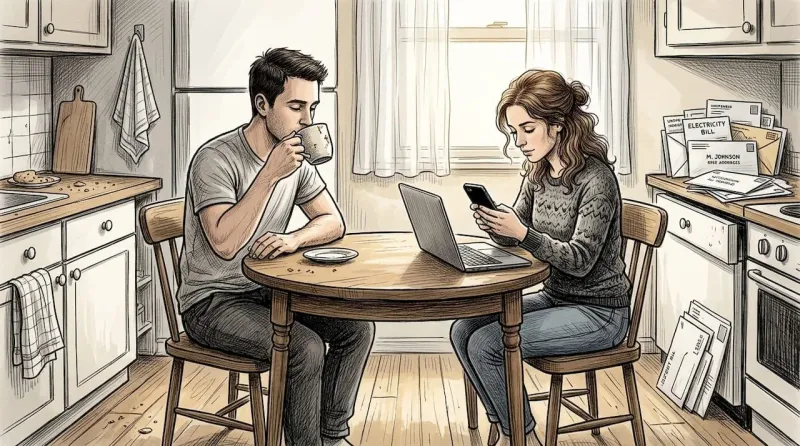
Some questions are worth sitting with privately, away from the noise of daily life and the pull of his reactions. They are not diagnostic tools and they will not tell you exactly what your relationship is. What they can do is help you hear your own voice more clearly.
Ask yourself: when you do something kind for him, does it feel like a genuine choice, or does it feel like the safest option available? There is a real difference between giving because you want to and giving because you are quietly afraid of what happens if you do not. That fear does not have to look dramatic. Sometimes it is just a low-level hum of anxiety that follows you through the day.
Ask whether disagreement feels safe. Can you tell him he is wrong, or that something he did hurt you, without bracing for anger, silence, sarcasm, or a punishment that arrives sideways later? Emotional safety within a relationship includes the ability to express your own perspective without fearing retaliation.
Ask whether generosity moves in both directions. Caring relationships involve mutual investment, not one person perpetually adjusting while the other stays still. Ask whether your boundaries, when you manage to state them, are treated as legitimate requests or as provocations. And ask, perhaps most pointedly, whether you feel chronically responsible for his emotional state in a way that leaves very little room for your own.
These questions are grounded in CDC guidance on autonomy and coercive control in relationships. They address dynamics and behavior, not personality types or childhood diagnoses. Whatever your answers reveal, they belong to you, and they are worth taking seriously.
Choose safety before confrontation

Recognizing a controlling or abusive pattern is one thing. Knowing what to do next is another, and the answer is rarely as simple as having a direct conversation or issuing an ultimatum. Some steps that feel logical, like confronting him with what you have noticed, or announcing that things need to change, can increase danger in relationships where control is already operating through fear.
Safer first steps tend to be private and small. If it feels safe to do so, keep a personal record of concerning incidents, including dates, what was said or done, and how it affected you. Tell at least one trusted person what is happening. Protect your access to money and your ability to communicate independently, because financial control and monitoring of devices are documented forms of coercive control.
The National Domestic Violence Hotline’s safety planning guidance notes that internet use may be monitored in some controlling relationships. If you have concerns about that, consider accessing resources from a device he does not control, such as a phone at a friend’s home or a library computer. The Hotline also offers a personalized safety planning tool that you can work through at your own pace.
Leaving is not always the immediately safest action. National health guidance on intimate partner violence acknowledges that danger can increase when a highly controlling partner realizes the relationship may be ending. Safety planning, which may include steps you take while still in the relationship, should be individualized and ideally developed with the support of a trained advocate.
If stalking, digital monitoring, threats of any kind, technology-facilitated abuse, or threats toward children or pets are present in your situation, specialized stalking safety planning is a more appropriate starting point than general boundary-setting advice. You can reach the National Domestic Violence Hotline at 1-800-799-7233, by text, or through online chat.
Let kindness include your freedom

Whatever a controlling relationship may have reinforced in you, it did not change who you are at the root. You can be warm without being endlessly available. You can hold space for another person’s pain without absorbing it as your own permanent responsibility. You can be generous without surrendering the right to say no.
The quality that makes you someone people lean on is real. The adaptations that taught you to lean back even when you are exhausted, to smooth things over even when you are the one who was hurt, to keep giving even when nothing comes back, those are learned responses, not fixed character. Recognizing the behaviors that define emotional abuse is one way to start separating what is yours from what the relationship has asked you to carry.
The most important question is not whether you are kind enough, or whether you have been too kind. The question is whether your care is voluntary, respected, and returned. A relationship that requires you to shrink, comply, or silence yourself to remain in it is not honoring your warmth. It is using it.
If anything here felt familiar, a quiet next step is enough. You do not need a diagnosis, a dramatic decision, or a complete plan before you begin. Private support is available, and your kindness, the real kind, includes being kind to yourself.