
Most women know the feeling of coming home and being met with questions before they even put their keys down. Where were you? Who were you with? Why didn’t you text back sooner?
After enough of those moments, some women simply stop explaining, and that silence gets treated like a confession. Whether that silence reflects exhaustion, a quiet reclaiming of privacy, or something else entirely depends on a lot more than one behavior.
Her silence may reflect exhaustion, not deception

Coming home should feel like relief. For some women, though, it feels more like walking into a deposition, where every errand, every conversation, and every unanswered text becomes a point of interrogation. After months or years of that, stopping the running commentary on her day isn’t a red flag. It may simply be what happens when a person gets tired of defending her ordinary existence.
That said, one change in behavior can’t tell you everything. Her decision to stop narrating her movements doesn’t automatically prove she’s hiding something, and it doesn’t automatically prove she’s reclaiming her power either. Behavior lives inside a larger story, and the meaning of this particular behavior depends on that story.
What the research does support is that repeated, intrusive demands for whereabouts can cross from normal communication into something more troubling. The National Domestic Violence Hotline notes that jealousy and monitoring are not signs of love but can be tools of control, and that a partner’s need to track her movements may have less to do with care than with power. When a woman feels like she needs to justify every trip to the grocery store, every phone call, and every minute she isn’t visible, the questioning itself has likely become the problem.
The premise here isn’t that she’s definitely honest or that interrogation definitely caused her silence. The premise is that her silence may reflect genuine exhaustion with a dynamic that made her feel like a suspect in her own home. Whether that exhaustion is the whole story, and what she might want to do about it, is worth examining carefully.
Privacy and secrecy are not the same thing
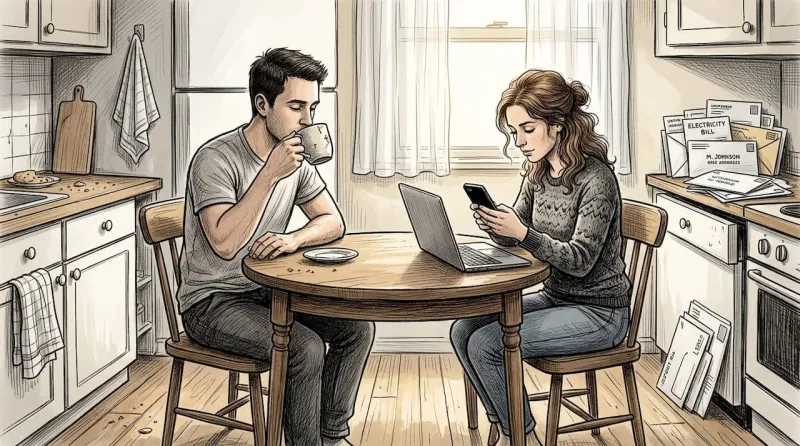
There’s a version of closeness that gets confused with total transparency, the idea that if two people truly trust each other, neither one should have anything they keep to themselves. That version of closeness isn’t intimacy. It’s surveillance dressed up as love.
Healthy relationships can absolutely include sharing plans, checking in, and coordinating daily life. Couples with kids, shared finances, or complicated schedules often need that kind of communication, and there’s nothing wrong with it when both people choose it freely. The difference shows up in how those arrangements are made and what happens when one person doesn’t comply.
Love Is Respect explains that healthy boundaries in a relationship are built on mutual respect, not on one person’s demands or another person’s fear. A check-in that both people agreed to, and that either person could renegotiate without punishment, looks very different from a daily requirement to account for every hour.
Wanting time that’s yours, friendships that don’t require a full report afterward, errands run without a text-by-text update, private conversations that stay private: none of that signals betrayal. People in healthy relationships still have inner lives. They still have friendships their partner isn’t part of. They still make choices without asking permission first.
Secrecy, on the other hand, usually involves actively hiding something that would matter to the other person, concealing it specifically to mislead. Privacy is different. Privacy is just the ordinary space a person takes up as an individual, even inside a committed relationship. Wanting that space back after it’s been taken isn’t the same as having something to hide.
The pattern becomes controlling when it shrinks her freedom

One question about where she is doesn’t define a relationship. A partner asking once after an unusual delay, or checking in during a genuine emergency, isn’t the same as building a system of daily surveillance. The concern grows when isolated questions become a persistent pattern, and when that pattern starts to shrink what she can do, where she can go, and who she can talk to.
The CDC identifies coercive control as a recognized form of intimate partner violence that includes psychological aggression, stalking, and behaviors specifically designed to monitor, restrict, and isolate a partner. The World Health Organization similarly describes controlling behaviors in intimate relationships as including monitoring a partner’s movements, cutting off contact with family and friends, and restricting access to money, work, education, or medical care.
Some warning signs that a pattern has moved beyond ordinary communication include repeated accusations of cheating without evidence, demands to know her location throughout the day, pressure to seek permission before making ordinary plans, control over what she wears or who she sees, surveillance of her phone or social media accounts, threats made when she doesn’t answer quickly enough, and humiliation when she pushes back. No single item on that list defines the relationship, but several of them together, especially when they’ve been building over time, suggest something more serious than a partner who just worries.
A systematic review published in PMC notes that researchers distinguish coercive controlling behavior from ordinary conflict partly by looking at whether there is an ongoing pattern of domination, isolation, intimidation, and restriction, rather than a single incident or disagreement. Using the term “coercive control” here is descriptive, not a legal conclusion. Definitions vary by state and by research context, and no article can diagnose a relationship from the outside.
What it can do is help her see whether the pattern, taken as a whole, is reducing her freedom to live an ordinary life.
What has she changed to avoid the next interrogation?

Sometimes the clearest signal isn’t what he does. It’s what she has quietly changed about her own life to avoid triggering a reaction.
Think about the last few months. Has she started leaving events early to make sure she’s home before he starts asking questions? Has she stopped mentioning certain friends because bringing them up leads to accusations? Does she check her own phone anxiously before he can, rehearsing how to explain a text message she hasn’t even received yet?
The Hotline’s guidance on emotional abuse describes exactly this kind of self-editing, where a person starts shrinking her own life to manage a partner’s reactions, as one of the quieter costs of a controlling dynamic.
A few reflective questions can help assess the pattern honestly. Does she feel like she could say no to a question about her whereabouts without consequences? When she doesn’t answer immediately, does she anticipate anger, accusations, the silent treatment, or something worse? Has she stopped doing normal things, taking a walk alone, having coffee with a coworker, keeping a personal journal, because those things invite interrogation?
Beyond location, it’s worth noticing whether monitoring extends to other areas. Is her phone checked without her permission? Are her finances controlled or watched? Has her access to transportation, friendships, or social media been restricted or commented on repeatedly?
Research on coercive control consistently finds that this kind of monitoring rarely stays in one area of a person’s life.
None of these questions can prove what her behavior means or confirm what kind of relationship she’s in. What they can do is help her see the cost of the dynamic clearly, because exhaustion and withdrawal may be telling her something she hasn’t let herself say out loud yet.
Jealousy does not justify surveillance

Jealousy is a feeling, not a license. Most people have felt it at some point in a relationship, and feeling it doesn’t make someone abusive or broken. The relevant question isn’t whether jealousy exists but what a person does with it.
A partner who feels jealous and brings it up honestly, “I’ve been feeling insecure lately, can we talk about it?” is doing something fundamentally different from a partner who responds to jealousy by checking her phone without permission, demanding hourly location updates, or accusing her of cheating every time she’s out of sight. One is communication. The other is control dressed up as emotion.
The Hotline’s piece on jealousy myths makes a point worth sitting with: jealousy is often framed as proof of love or deep caring, but that framing can be used to normalize behavior that is actually about power and possession. When his jealousy becomes the reason she can’t have a conversation without explaining it afterward, the jealousy has stopped being a feeling and started being a mechanism.
Connecting surveillance to the relationship’s power dynamic doesn’t require diagnosing him with a personality disorder or declaring him a villain. Controlling behavior can exist without a clinical label, and attaching one wouldn’t change what she’s experiencing anyway. What matters is whether his way of handling jealousy expands or shrinks her freedom, whether she can disagree with him, spend time with her own people, and make her own choices without facing accusations, restrictions, or punishment.
When the answer to those questions is consistently no, the issue is no longer just jealousy.
A boundary can clarify the relationship’s terms

If the situation feels safe enough to address directly, one option is a clear, low-drama statement about what she will and won’t continue to do. Something like: “I’m happy to share plans when it’s relevant to both of us, but I’m not going to keep providing a constant report of my movements.” That’s not an ultimatum. It’s a description of a reasonable expectation.
Love Is Respect emphasizes that boundaries in a healthy relationship are set to protect your own wellbeing, not to control another person, and that a partner who respects you will respond to a stated boundary with conversation rather than retaliation. A respectful partner might push back, ask questions, or need some time to adjust. He might want to talk through what kind of check-ins actually work for both of them. That’s a reasonable response.
What’s not a reasonable response is escalating the monitoring, threatening consequences, or treating a stated boundary as evidence of guilt. If that’s the reaction, the boundary hasn’t failed. It has revealed something important about the dynamic that was already there.
This option only makes sense when it feels genuinely safe to use it. The Hotline’s safety planning guidance is clear that announcing a new boundary to a partner who has been threatening, surveilling, or using force is not a neutral act. If she has reason to believe that a direct conversation could trigger harm, that conversation may need to wait, or may not be the right move at all. Protecting herself is more important than proving a point, and there are other ways to take steps toward safety that don’t require a confrontation first.
Safety comes before proving a point

When a controlling dynamic includes threats, physical force, stalking, weapons, or digital surveillance, the calculus changes. Stopping explanations abruptly, announcing a new boundary, or even searching for help online can carry real risk if a partner is monitoring her devices, tracking her location, or has a history of responding to perceived defiance with force.
The Hotline’s guidance on safety planning while still in the home recommends identifying safe areas in the house, keeping access to a phone, involving trusted people who know what’s happening, documenting abusive behavior when it’s safe to do so, and thinking carefully about a partner’s access to weapons or history of using force. These steps don’t require her to leave immediately. They’re about building a margin of safety while she figures out what comes next.
Digital safety matters too. The Hotline’s stalking safety planning resource explains that phone, email, social media, GPS, hidden cameras, and monitoring software can all be part of technology-facilitated abuse. If she suspects her devices are being monitored, searching for help from a safer device, a public computer, or a phone that isn’t connected to a shared account may be an important first step before anything else.
For anyone in immediate danger in the United States, 911 is the right call. The National Domestic Violence Hotline offers confidential support by phone at 1-800-799-SAFE (7233), by text at START to 88788, and by chat online. Reaching out doesn’t commit her to any particular path. The Hotline’s safety planning tool can help her think through her specific situation, and their post-departure resources exist for whenever and however she decides to move forward.
Support is available whether she’s still deciding, still in the home, or somewhere in between.
She deserves privacy without needing certainty first

She doesn’t need to have everything figured out before she’s allowed to want something different. She doesn’t need to confirm that she’s being abused, or prove that her exhaustion is justified, or know exactly what she plans to do next, before her desire for privacy becomes legitimate.
Love Is Respect and The Hotline’s emotional abuse resources both reflect the same underlying principle: a person’s right to basic autonomy, to exist in a relationship without constant surveillance or self-justification, doesn’t have to be earned or proven. It’s a baseline, not a reward for good behavior.
The more useful question isn’t whether she’s hiding something or reclaiming her power. It’s whether this relationship allows her to live an ordinary life without fear, surveillance, punishment, or the daily exhaustion of defending herself. That question is worth sitting with, carefully and honestly, because the answer tends to point toward what she actually needs to do next.
A woman who stopped explaining herself may be many things. Tired is the one that deserves to be taken seriously first.