
Some women walk out of a marriage and feel, for the first time in years, like they can breathe again. That quiet is not proof they have healed completely, and it is not proof they are bitter either. For some, it is simply what happens when a relationship that cost them more than it gave them finally ends. This article explores what that shift can feel like, what research says about it, and what honest rebuilding actually looks like.
When the quiet in the house feels like relief

Quiet can be disorienting after a long marriage. The absence of another person’s footsteps, opinions, and schedule can feel strange before it feels freeing, and sometimes it cycles between both in the same afternoon. So when a woman sits in her living room after a separation and notices something that feels like peace, she may not know quite what to call it.
The title of this article frames her story a particular way, but the honest version is softer. We do not know whether she is bitter or healed, whether she owns the house outright, or what her finances look like. What some women do report, though, is that the end of a relationship that was chronically draining created room they had not felt in years. Research on women in very low-quality marriages suggests that some gain life satisfaction after divorce relative to women who stayed in similarly poor marriages.
That is a real and meaningful finding, even if it does not apply to every woman or every circumstance.
Relief and grief are not opposites. A woman can feel lighter and also feel the particular sadness of a life that did not go the way she planned. She can feel proud of her decision and still grieve the version of the relationship she had once hoped for. Studies on relationship dissolution show that changes in life satisfaction after a breakup are shaped by many factors, including how the relationship ended and what the person wanted from it.
The home, if she is still in it, becomes a space where small choices accumulate. How she arranges the furniture. What she keeps and what she donates. When she eats dinner.
None of that proves she is thriving, but it can be the beginning of organizing a life around her own preferences rather than around a set of accommodations that no longer serve her.
Marital quality matters more than marital status

Marital status alone, whether someone is married, separated, or divorced, turns out to be a poor predictor of how a person feels. What matters far more is what the marriage was actually like. Longitudinal research on marital quality and life satisfaction found that women in very low-quality marriages were more likely to gain life satisfaction after divorce compared to women who remained in similarly poor marriages. Women in higher-quality marriages did not show the same pattern.
That distinction is worth sitting with. Divorce does not automatically improve anyone’s life. The relief that some women feel after leaving is more likely tied to the end of chronic conflict, disappointment, or emotional exhaustion than to the simple fact of being single. The house, the solitude, the new schedule, none of those things are inherently healing.
What changes is the daily texture of a relationship that was costing more than it was returning.
Who initiated the separation also appears to matter. Research on initiators and noninitiators found that people who chose or drove the separation tended to show better post-separation subjective well-being on average than those who were left or blindsided. That is an average pattern, not a guarantee. A woman who chose to leave can still feel devastated.
A woman who was left can still find her way to something better.
These findings support a qualified possibility, not a promise. For some women, ending a marriage that was chronically low in quality creates conditions where life satisfaction can rise. For others, the picture is more complicated, shaped by finances, children, health, safety, and whether the support they needed was actually available to them. The research opens a door; it does not walk through it for anyone.
The work of accommodation can become visible afterward

One of the stranger parts of life after a long relationship is noticing how much of your routine was built around someone else. The dinner timing, the volume of the television, the routes you took, the hobbies you quietly set aside. These adjustments happen so gradually that they stop feeling like adjustments at all. They just become how things are.
After a separation, some women describe a slow and sometimes disorienting process of rediscovering their own preferences. Not in a dramatic way, but in small, practical ones. Realizing they like the bedroom cooler. Keeping the kitchen the way they want it.
Making plans without checking anyone else’s calendar. Whether this registers as freedom or as loneliness, or as both at once, depends entirely on the person and the day.
There is a broader social pattern worth naming here, carefully. The 2025 American Time Use Survey found that women spent more average daily time on household activities than men, 2.38 hours compared to 1.58 hours for adults overall. The full survey data reflects population-level patterns across many households, not the specific circumstances of any one marriage. It does not tell us what a particular spouse did or did not do, or what he felt or intended.
What it does suggest is that many women carry a significant share of domestic work, and that this is common enough to show up clearly in national data. For some women, recognizing the weight of that labor, once the relationship changes and the demands shift, is part of how they begin to understand what they were carrying. That recognition is a subjective experience, not a verdict about anyone else.
Living alone is not the same as being lonely
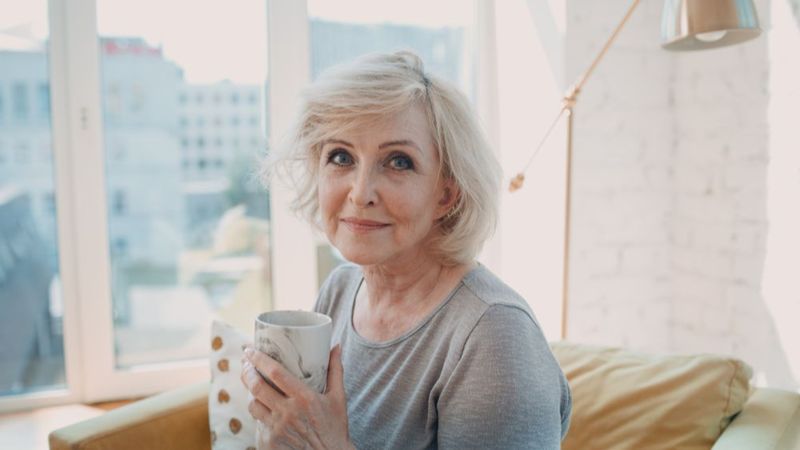
Physical solitude and loneliness are two different things, and the difference matters more than it might seem. A woman can live without a partner and still have a full social life, close friendships, family who calls, neighbors she trusts, and a community she is genuinely part of. Conversely, someone can share a home with another person for years and feel profoundly alone inside that arrangement.
Research associating living alone with higher rates of psychiatric morbidity is largely observational, which means it can identify patterns but cannot prove that living alone caused the distress. Other factors, including financial stress, health challenges, age, and social isolation, are often intertwined with living arrangements in ways that make simple conclusions unreliable. Neither solitude nor partnership is automatically healthy.
For some women, the first months alone after a long marriage are genuinely hard. The evenings are quiet in a way that takes getting used to. The weekends can feel unstructured. Earlier research on divorced women found that social support and income were among the factors most strongly connected to better adjustment.
Social connection, in particular, was not incidental. It was central.
For women who are also mothers, the picture is different again. Living without a partner does not mean living without company or without substantial daily demands. Co-parenting, school schedules, and the constant logistics of raising children mean that many divorced mothers are far from alone in any practical sense. Research on older divorced women found that social support can moderate the relationship between divorce and depressive symptoms, suggesting that connection to others remains one of the more reliable protective factors available, whatever the living arrangement.
A home becomes more like hers through small decisions

Rebuilding after a separation rarely looks like a single decisive moment. More often it is a series of small choices made over weeks and months, some of them practical, some of them emotional, and some of them so minor they would seem unremarkable to anyone watching from the outside.
Deciding where the couch goes. Cooking what she actually wants for dinner. Keeping a schedule that matches her energy rather than someone else’s. These are not dramatic acts of reinvention, but they can add up to something real.
Research on post-divorce trajectories identifies several different paths, including recovery, ongoing distress, and personal growth, and makes clear that there is no single normal emotional timeline. Some women feel steadier within months. Others take much longer. Both are legitimate.
Social support keeps appearing in the evidence as a meaningful factor. Reconnecting with friends, spending time with family, and maintaining relationships that feel genuinely reciprocal are associated with better adjustment. Earlier research on divorced women and more recent work on older women navigating marital transitions both point to connection as a buffer rather than a bonus.
Practical habits also carry weight. MedlinePlus guidance on managing stress and recommendations for improving mental health both name regular sleep, physical movement, meaningful activity, and connection as potentially helpful supports during stressful life transitions. These are not cures, and they are not mandatory steps. They are options that some people find useful as they try to build a life that feels more like their own.
Setting limits around contact that feels draining or destabilizing can also matter, though what those limits look like depends entirely on individual circumstances, including whether children are involved, what legal obligations exist, and what is actually safe.
Autonomy does not erase financial or parenting pressure

The image of a woman reclaiming her space after divorce can carry a certain warmth. But the material reality of separation often runs alongside the emotional one, and it is rarely as tidy. Feeling calmer and facing genuine financial pressure are not mutually exclusive. Both can be true at the same time.
Government Accountability Office research on the economic consequences of divorce documents that separation can reduce assets and economic well-being, particularly for women in more vulnerable circumstances. Additional GAO analysis examined how divorce affects financial security across different groups, underscoring that the economic impact is real and uneven. Housing costs, health insurance, retirement savings, and childcare expenses do not pause because a relationship has ended.
For women who are also mothers, the post-divorce household is not an empty nest of reclaimed solitude. It is often a household still running at full capacity, just with one fewer adult. School pickups, pediatrician appointments, homework, and the emotional labor of helping children through their own adjustment all continue. The workload does not shrink; it redistributes.
Official resources exist for women navigating these pressures. USAGov’s housing help page provides pathways to housing assistance and emergency rent support, and the benefit finder tool can help identify programs a woman may qualify for based on her specific situation.
Co-parenting contact can add its own layer of stress. One longitudinal study found that ongoing contact with an ex-partner was associated with psychological distress after marital separation. That does not mean all contact is harmful or that cutting it off is always possible or wise, especially where children are involved. It means the stress is real, and it deserves to be named rather than minimized.
Danger changes what a fresh start requires

Most of what gets written about post-divorce rebuilding assumes that the primary challenge is emotional: finding yourself again, adjusting to solitude, rebuilding routines. For some women, that framing misses something far more urgent.
When a former relationship involved coercive control, threats, stalking, or violence, separation can mark the beginning of a more dangerous period rather than a safer one. The dynamics that made the relationship harmful do not automatically end when the legal or physical separation begins. A woman in this situation needs guidance that is specific to her safety, not generic encouragement to announce her new boundaries or simply move on.
The National Domestic Violence Hotline’s guidance on safety planning outlines why individualized plans matter before, during, and after leaving, and why digital privacy, including who has access to accounts, devices, and location information, is part of that picture. Safety planning is not a single conversation. It is an ongoing, adaptable process that accounts for children, shared spaces, legal proceedings, and contact that may be unavoidable.
If any of this feels relevant, the most useful next step is not a checklist from a general article. Trained advocates at the National Domestic Violence Hotline can be reached by phone, text, or online chat and can help think through what is specific to a woman’s situation. The guidance they offer is individualized in a way that no article can replicate.
Framing post-divorce life as a fresh start is reasonable for many women. For others, the first priority is making sure the next chapter is safe enough to actually begin. That distinction deserves to be said plainly, not tucked into a footnote.
Relief does not have to cancel grief

Somewhere along the way, the story of a woman rebuilding after divorce gets sorted into two categories: bitter or better. Neither one leaves much room for the actual texture of it, which tends to be messier, more contradictory, and more human than either label allows.
A woman can feel relief and grief at the same time. She can feel proud of herself and still cry over something small on a Tuesday evening. She can be glad the marriage ended and still mourn the version of it she had once believed in. Research on post-divorce trajectories is clear that recovery, continuing distress, and personal growth can all occur, sometimes in the same person across different periods, and that there is no prescribed timeline for any of it.
Relief is not proof of healing. Healing is not proof that the decision was easy or that the grief was not real. A woman who feels calmer in her own home after separation is not required to perform certainty about any of it. The peace and the pain can coexist without canceling each other out.
When distress becomes persistent, interferes with daily life, or starts to feel unmanageable, support matters. MedlinePlus guidance on stress recommends seeking professional help when severe symptoms last two weeks or more or make ordinary functioning difficult. For anyone in the United States experiencing thoughts of suicide, 988 connects to the Suicide and Crisis Lifeline by call or text.
The home, however it came to be hers, is not the end of the story. What she does with the quiet, the space, and the next chapter belongs entirely to her. That is not a small thing.