
Every year, the calls come right on schedule: a few weeks before the holiday, someone from his family reaches out, and somehow the conversation always lands on what she plans to cook. She shows up, feeds everyone, cleans up, and drives home exhausted while the evening is still being described as a success. If that rhythm has started to feel less like belonging and more like a job she never applied for, you are not imagining things. This article looks honestly at what that pattern might mean, what the research actually says about unequal domestic labor, and what she can do about it without guilt.
When an invitation starts to feel like an assignment

Picture the moment the phone lights up with a message from someone in his family. Your first instinct, before you even read it, is a small knot in your stomach, because you already have a pretty good idea of what it says. Not “we miss you” or “how have you been” but something closer to “are you making your famous casserole this year?” That gut reaction is worth paying attention to.
Observable patterns matter more than any single invitation. Think about whether the calls tend to arrive close to a holiday. Consider whether the conversation quickly moves toward menus, timing, or how many people are coming. Notice whether the same people who need to know what you are bringing also check in during ordinary weeks just to talk.
None of these observations proves anyone’s private motive, but together they can tell you something real about how the relationship operates in practice.
Research on social support finds that perceived imbalance between what a person gives and what she receives is associated with poorer psychological well-being, though studies on reciprocal and nonreciprocal social support also show that support exchanges are complex and vary by relationship type and life stage. What she observes is a pattern, not a verdict about anyone’s character.
Resistance when she declines, limited appreciation after she delivers a full meal, or a noticeable drop in contact once the holiday passes are all worth noting. Each data point on its own is thin. Across several gatherings and multiple seasons, they start to form a clearer picture. This article is not about declaring every request for cooking exploitative.
It is about helping you ask honestly whether the arrangement you have been living inside is one you actually chose, and whether it still fits.
The real workload begins before anyone sits down

Long before the first guest walks through the door, a holiday meal is already well underway. Someone decided whether to host. Someone sent the invitations or made the calls. Someone remembered that one relative avoids gluten, that another brought a new partner last year whose dietary needs are still unclear, and that the table only fits twelve if you borrow chairs from the garage.
That someone is probably you.
Researchers who study household labor describe this kind of work as cognitive labor: the planning, anticipating, scheduling, delegating, reminding, and monitoring that keeps a household or an event running. A study on cognitive household labor and maternal well-being found that women, particularly mothers in heterosexual relationships, tend to carry a disproportionate share of this invisible management work, not just the physical tasks anyone can see. The grocery run and the roasting pan are visible. The mental file containing everyone’s preferences, the timeline that accounts for oven space, and the quiet monitoring during the meal to make sure nothing is running out are largely invisible.
A systematic review examining the cognitive dimension of unpaid household work found that gendered expectations, not innate ability, shape who ends up managing this mental workload. Cooking skill or enjoyment does not automatically create an obligation to also carry the planning, the coordination, and the cleanup.
A practical self-audit can help clarify what you actually own. Write down every step of the hosting process in order: deciding to host, setting the date, inviting people, planning the menu, shopping, coordinating who brings what, scheduling cooking times, preparing the food, serving, monitoring the event, handling unexpected needs, cleaning, and storing leftovers. Then mark honestly which of those steps you handled alone, which someone else initiated, and which were genuinely shared. The list tends to be more revealing than any single conversation about fairness.
Why repeated inequity can wear her down

Agreeing to host once, even enthusiastically, does not mean the arrangement was designed to be permanent. Many women say yes the first time because they genuinely want to contribute, because it feels easier than negotiating, or because no one else stepped up. What starts as a generous offer can quietly calcify into an expectation, and expectations are much harder to renegotiate than original plans.
Research on cognitive household labor suggests that carrying a greater share of this invisible management work is associated with more stress, burnout, depressive symptoms, and lower relationship quality. A study of 322 mothers of young children found that higher cognitive household labor responsibility was linked to poorer mental health and well-being outcomes. Because the study was observational and relied on self-report, it shows an association rather than proof that the labor directly caused those outcomes, and it focused on mothers within couples rather than women hosting extended family for holidays specifically. Still, the direction of the finding is consistent: carrying more of the invisible work tends to cost something.
Perceived fairness appears to matter alongside the actual count of tasks. A large study found that people’s sense of being treated unfairly in housework was connected to lower relationship satisfaction and other relationship quality measures. The sample came from an online news website, which limits how broadly the findings can be applied, and the research examined couples rather than extended-family holiday arrangements. What it suggests, carefully, is that the feeling of unfairness carries weight of its own, separate from whether an outside observer would count the tasks and agree the split is unequal.
None of this research is a verdict about your relatives or your relationship. What it offers is context: the tiredness you feel after hosting alone is not weakness or ingratitude. Repeated inequity, even when no one intended it, has a cumulative effect on a person’s capacity and her sense of being seen.
Look at the whole relationship, not just the meal
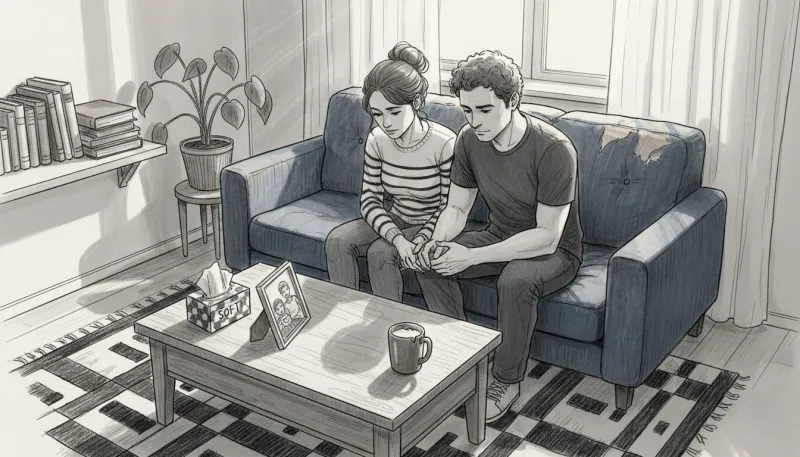
Before drawing a firm conclusion about why the arrangement exists, it is worth sitting with the less comfortable explanations. A family may rely on one person’s cooking because of long-standing tradition, because finances make catering or restaurant meals impractical, because someone in the family has a disability that limits their ability to host, or simply because no one ever questioned who would take the lead. Those explanations do not automatically make the arrangement fair or fully voluntary. They do complicate the idea that the pattern is necessarily intentional.
Reciprocity in relationships is rarely a clean, one-for-one accounting at every event. Research on reciprocal social support finds that support exchanges vary by relationship type and life stage, and that balance is often assessed across time rather than within a single gathering. Someone who does not cook may contribute through transportation, childcare, financial help, emotional support during a hard season, or practical care at another time. The question worth asking is whether the broader exchange, across months and years, feels mutual enough to be sustaining.
A more useful diagnostic question than “why don’t they help more” is this: does contact remain warm and consistent when you are not producing a meal? Do people call to check on you in February, when there is no holiday on the horizon? Do they notice and name what you contribute, or does the food simply appear and disappear without comment? A study on perceived fairness in household labor suggests that acknowledgment and recognition are part of what shapes whether an arrangement feels equitable, not only the raw division of tasks.
Culture, habit, and assumption also shape these dynamics in ways that are real without being malicious. Some families grew up watching one woman run every holiday without complaint and genuinely have not thought to question it. That does not make the pattern fine, but it does mean that the starting point for change may be a conversation rather than a confrontation, and that the response to that conversation will tell you a great deal about what is actually possible.
A boundary can change the hosting arrangement

Stepping back from a hosting arrangement you did not fully choose is not a punishment and it is not a withdrawal of love. A boundary, practically speaking, is a statement of what you will do, not an attempt to control what anyone else thinks or feels about it. “I am not hosting this year” is a boundary. “You are required to appreciate me” is not.
The options available to you are more varied than a simple yes-or-no to the whole holiday. You could stop hosting at your home while still attending elsewhere. You could agree to bring one defined dish instead of preparing an entire meal. You could participate only if the event is potluck-style, so the cooking is genuinely distributed.
You could ask that specific tasks be assigned and confirmed before you agree to anything. You could propose rotating hosts so the labor moves around the family over time. Any of these is a legitimate renegotiation, not a declaration of war.
Research on household coordination suggests that talking explicitly about who owns each task is associated with a more equitable division of work and better relationship quality. A diary study found that parental coordination around household tasks was linked to greater perceived fairness and more equal task-sharing. Naming task ownership clearly, rather than making a vague request for “help,” is a practical application of that finding, though it has not been tested specifically in extended-family holiday settings.
University of Minnesota Extension guidance, developed primarily for families navigating two-home arrangements after divorce or separation, offers a principle that adapts usefully here: families can alter or drop traditions that create excessive stress and build new ones that actually work for everyone involved. Planning celebrations in advance and distributing responsibilities clearly can reduce the friction that builds when expectations go unspoken.
If you do continue preparing food, basic safety still applies: use a food thermometer, keep raw meat separate from ready-to-eat foods, refrigerate perishables within two hours, and reheat leftovers to 165 degrees F. CDC food-safety guidance is straightforward and worth a quick review before any large gathering.
Read the response without turning it into a diagnosis

After you state your limit, something will happen. People will react. The reactions you get are genuinely informative, but they are not a complete map of anyone’s character, and a single response to a single refusal is not sufficient evidence to draw permanent conclusions about who values you and who does not.
Ordinary disappointment is not a red flag. A family member who says “oh, that is too bad, we were counting on your cooking” and then moves on to figuring out a different plan is navigating a change, not punishing you. Negotiation, mild frustration, and even a few days of awkwardness are normal human responses to a shift in an established pattern. They do not mean the arrangement was coercive or that you were wrong to change it.
What is worth paying closer attention to is a pattern of repeated pressure after you have already said no, guilt-tripping that escalates rather than settles, threats, or attempts to involve your partner in reversing your decision through sustained campaigning. Those behaviors are different in kind from disappointment, and they suggest something more concerning about how your limits are received. The response to your boundary is information about whether others can respect it and share the work going forward. It is not, by itself, proof of what the old arrangement was or what anyone secretly intended.
One disagreement does not establish coercive control. Repeated intimidation, monitoring, retaliation, financial pressure, or isolation are a different category of concern entirely. If saying no to hosting, or to any increased independence, has ever been met with behavior that frightened you or felt unsafe, generic boundary-setting advice is not the right tool. The National Domestic Violence Hotline recommends individualized safety planning when a partner’s reactions to independence could escalate dangerously, because a well-worded statement is not protection against someone who responds to limits with harm.
Safety planning should come before continued explanation in those circumstances.
She can leave the kitchen without abandoning connection

Declining to be the default cook, the planner, the host, and the cleanup crew does not make you selfish. Belonging to a family should not require purchasing your place at the table with unpaid labor, season after season, without acknowledgment or reciprocity. Caring about connection and refusing to carry an unfair arrangement are not opposites.
The next one or two gatherings where you are not the one running the kitchen will tell you something worth knowing. Watch who reaches out before the holiday with something other than a logistics question. Notice whether anyone steps up to fill the coordination gap, or whether the event simply does not happen without your labor holding it together. Pay attention to whether appreciation for what you used to do finally becomes visible now that it is absent, or whether the absence goes unremarked.
As family stress research suggests, traditions that no longer serve everyone involved can be altered or replaced, and the process of changing them often clarifies what the tradition was actually for.
One event will not answer every question. Patterns reveal themselves over time, across seasons and circumstances, and the picture you build from several data points will be more accurate than any single holiday. Research on reciprocal social support is consistent on this point: balance in relationships is assessed across time, not within a single exchange.
You get to define what reciprocal connection actually looks like for you. That definition does not have to match anyone else’s, and it does not have to be announced or defended. The woman who steps away from the stove and sits down at the table as a guest is not abandoning her family. She is finding out whether her family will meet her there.