
Twenty-one minutes. That’s all it took for a battered, modified, fifty-seven-year-old Fender Stratocaster to obliterate every record in the history of guitar auctions. When the hammer fell at Christie’s on the Jim Irsay Collection sale, David Gilmour’s legendary Black Strat had changed hands for $14.55 million — more than double what anyone had ever paid for a guitar, and nearly triple what Irsay himself shelled out for it just seven years ago.
The number is staggering. But the real story isn’t about money. It’s about what happens when an instrument becomes inseparable from the music that defined an entire generation.
A $50 Guitar from a Manhattan Shop
The origin story is almost comically modest. In 1970, a young David Gilmour walked into Manny’s Music on West 48th Street in Manhattan — the same cramped, legendary shop where Hendrix browsed and Clapton haggled — and picked up a black 1969 Fender Stratocaster. The exact price has been lost to time, but guitars like it sold for around $300 new. Adjusted for inflation, we’re talking about a purchase that cost roughly what a decent bicycle costs today.
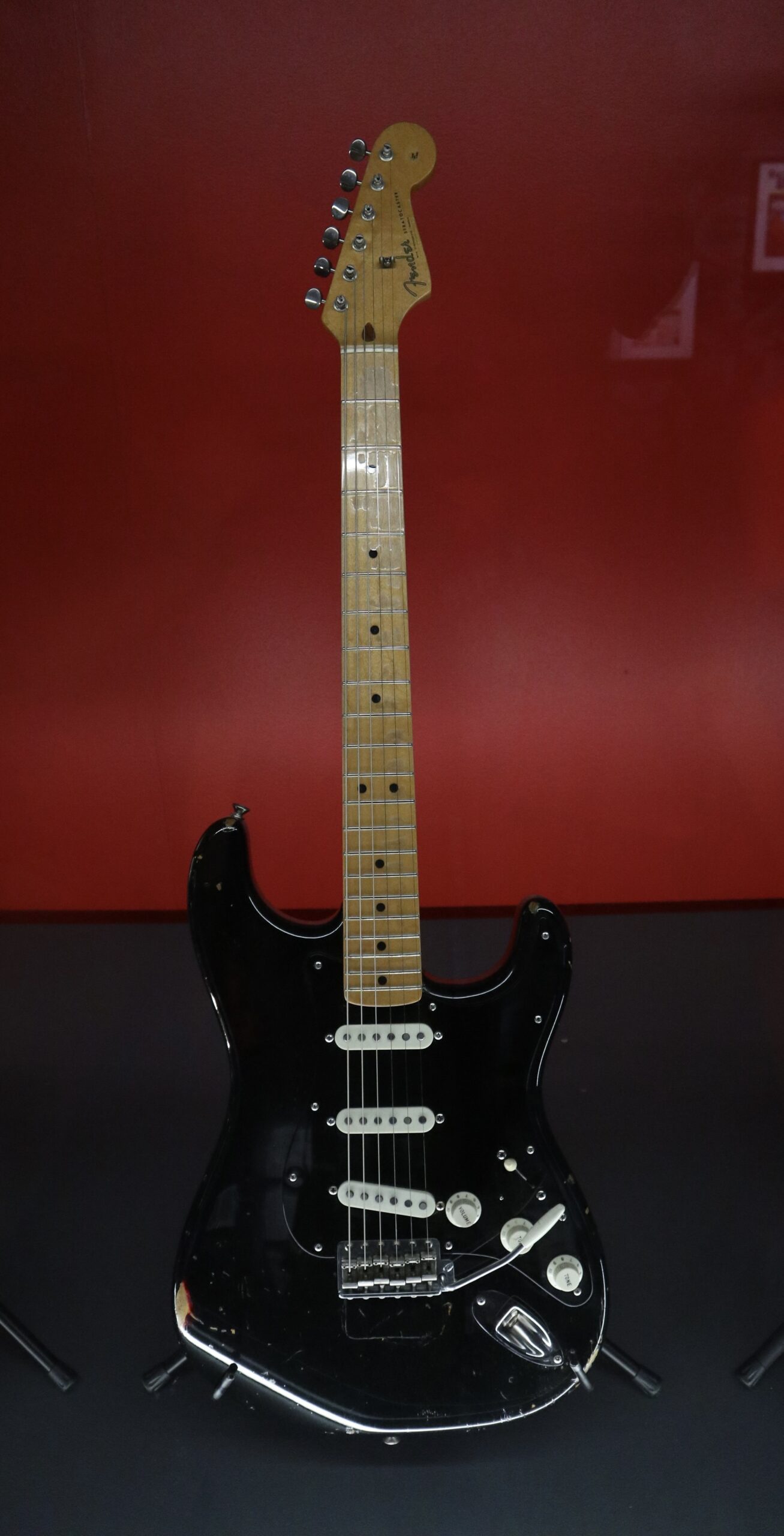
What Gilmour couldn’t have known — what nobody could have predicted — was that this particular guitar would go on to shape the sound of rock music more profoundly than almost any other single instrument in existence.
The Sound of the Dark Side
The Black Strat wasn’t just Gilmour’s guitar. It was the guitar. His primary instrument for the better part of fifteen years, it became the sonic engine behind Pink Floyd’s most transcendent work. The shimmering, weeping tones of The Dark Side of the Moon. The aching sustained notes of “Shine On You Crazy Diamond” on Wish You Were Here. The industrial snarl of Animals. The theatrical fury of The Wall.

Think about what that means for a moment. The guitar solo on “Comfortably Numb” — routinely voted the greatest guitar solo ever recorded — was played on this instrument. The opening cash register riff of “Money,” which introduced millions of listeners to the concept of odd time signatures without them ever realizing it, came through these pickups. Every note of “Shine On You Crazy Diamond,” Gilmour’s devastating elegy for Syd Barrett, was coaxed from these six strings.
This isn’t a museum piece that sat behind glass. This is the tool that built a cathedral of sound.
Why Jim Irsay Paid Twice
Jim Irsay, the owner of the Indianapolis Colts, first acquired the Black Strat in June 2019 when Gilmour auctioned off his personal guitar collection at Christie’s in New York. That sale was itself a landmark event — 120 guitars selling for a combined $21.5 million, with all proceeds going to ClientEarth, a climate change charity. Irsay walked away with the crown jewel for $3.975 million, which set a new world record at the time.
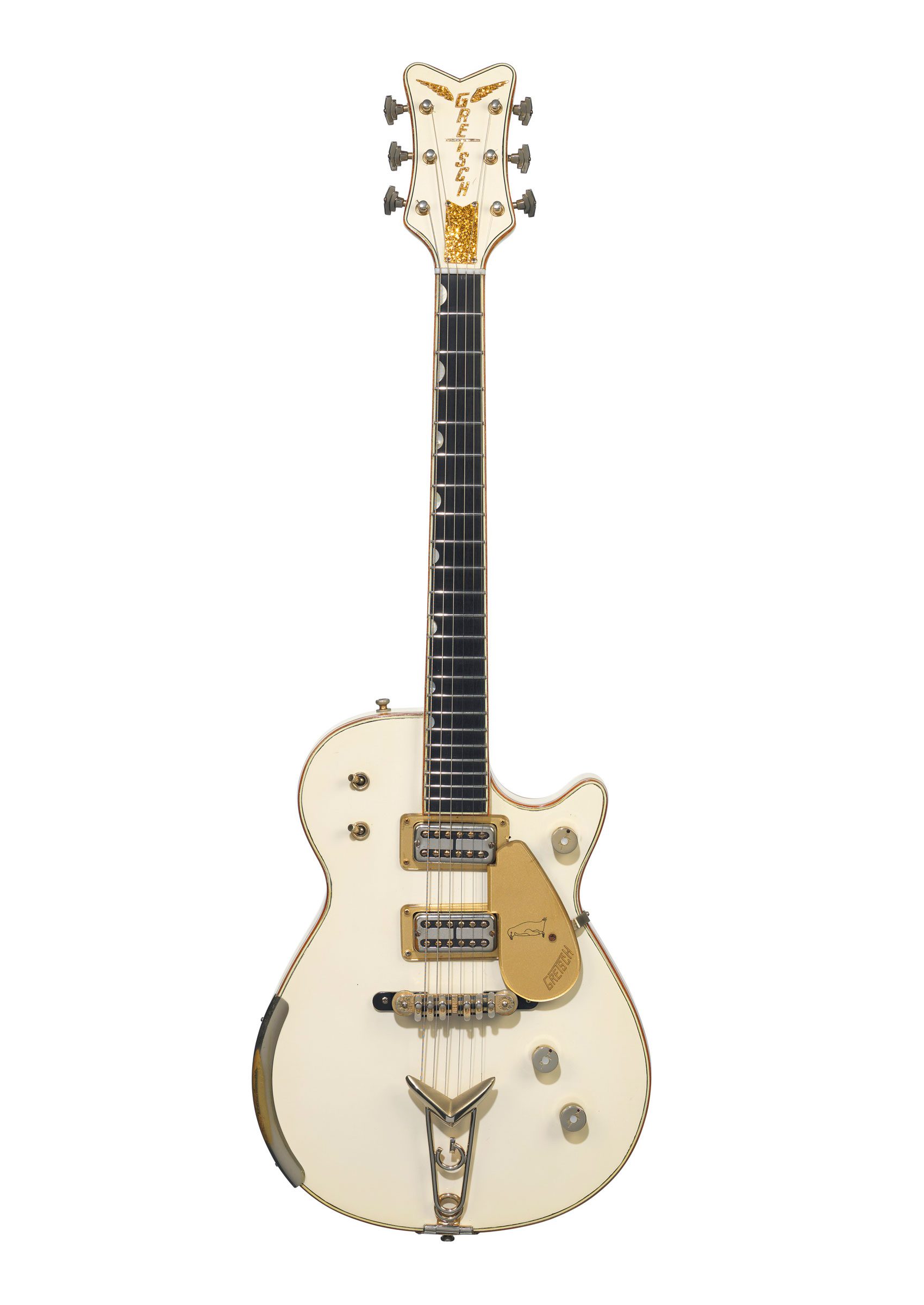
So why did it sell again — and for nearly four times the price? Irsay, a passionate collector of rock memorabilia (his collection includes instruments owned by Jerry Garcia, Prince, Bob Dylan, and John Lennon), consigned a number of pieces through Christie’s. The sale became the biggest guitar auction in history, and the Black Strat was its undisputed headliner.
The previous record for any guitar sold at auction was held by Kurt Cobain’s 1959 Martin D-18E — the acoustic he played during Nirvana’s legendary MTV Unplugged performance in 1993 — which sold for $6 million in 2020. The Black Strat didn’t just beat that record. It obliterated it by $8.55 million.
More Than Wood and Wire
There’s an argument to be made that paying $14.55 million for a guitar is absurd. After all, Fender still makes Stratocasters. You can buy a brand-new one for under a thousand dollars. The Fender Custom Shop even produces a David Gilmour Signature model that replicates every modification Gilmour made to the original — the shortened tremolo arm, the specific pickup configuration, the black nitrocellulose finish.

But that argument misses the point entirely. Nobody is paying $14.55 million for the wood, the pickups, or the tremolo system. They’re paying for provenance — for the singular fact that this piece of maple and alder was in David Gilmour’s hands when he channeled something that felt, to millions of listeners, like the sound of human consciousness itself.
Guitars absorb the identity of their players in a way few other objects can. The wear patterns on the frets tell the story of specific chord voicings. The scratches on the pickguard map thousands of hours of practice and performance. The Black Strat carries the physical memory of every note Gilmour pulled from it across three decades, four era-defining albums, and uncountable live performances.
The Last Dance at Live 8
The final time Gilmour played the Black Strat with Pink Floyd was at Live 8 in Hyde Park, London, on July 2, 2005. It was the first time the band had performed together in 24 years — Gilmour, Roger Waters, Nick Mason, and Richard Wright, reunited on stage before 200,000 people. When Gilmour launched into the solo on “Comfortably Numb” with the Black Strat one last time, it felt like the closing of a chapter that could never be written again.
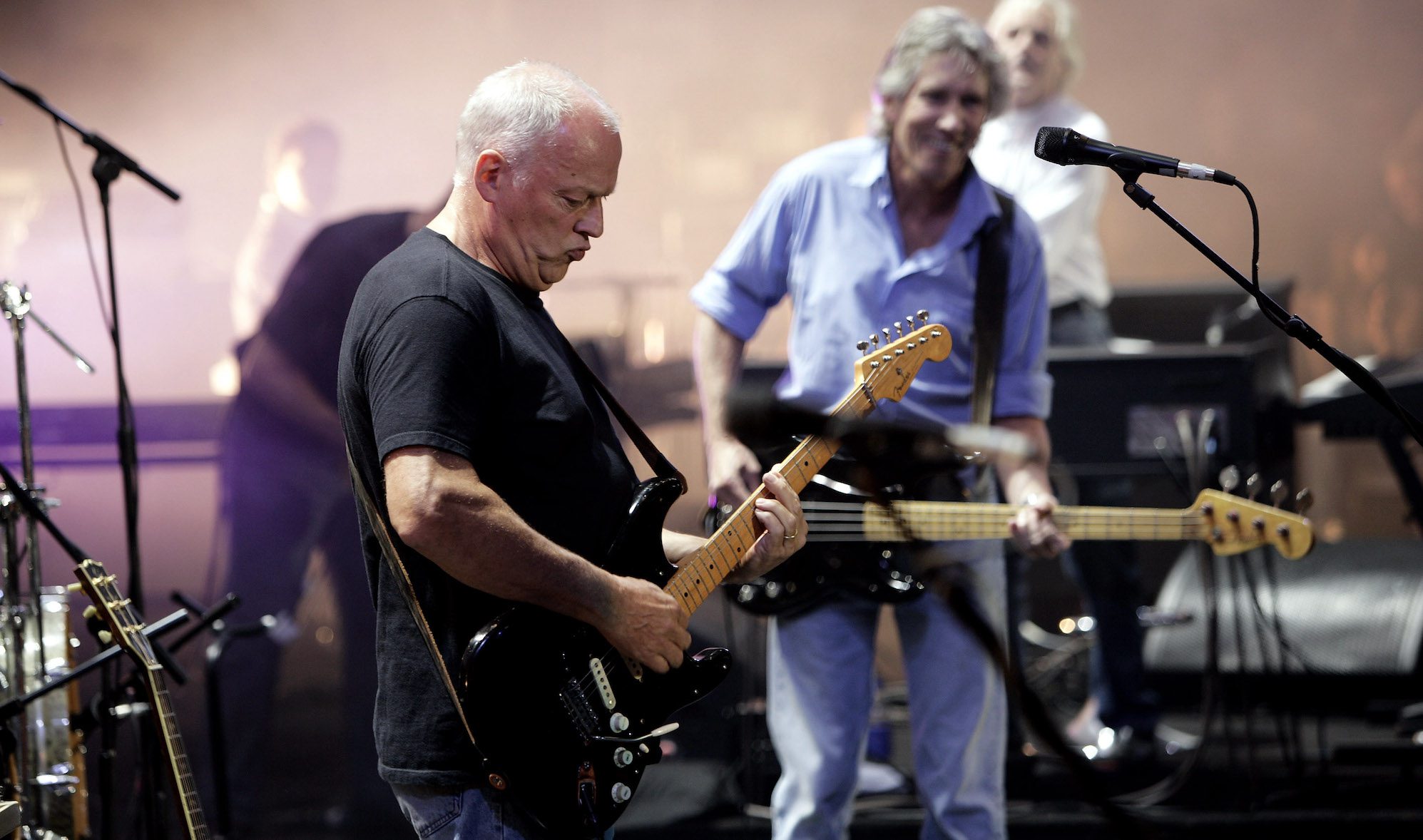
Richard Wright died three years later. The reunion was never repeated. And the guitar that had been Gilmour’s voice through the most creatively fertile period in rock history was eventually offered up for charity, then for collection, and now — at $14.55 million — has become the most valuable guitar on earth.
What a Price Tag Really Means
Every few years, the art and collectibles world produces a number that forces people to reckon with what we actually value. A Basquiat sells for $110 million. A Picasso sketchbook goes for $36 million. A baseball card fetches $12.6 million. Each time, the question is the same: Is anything really worth that much?
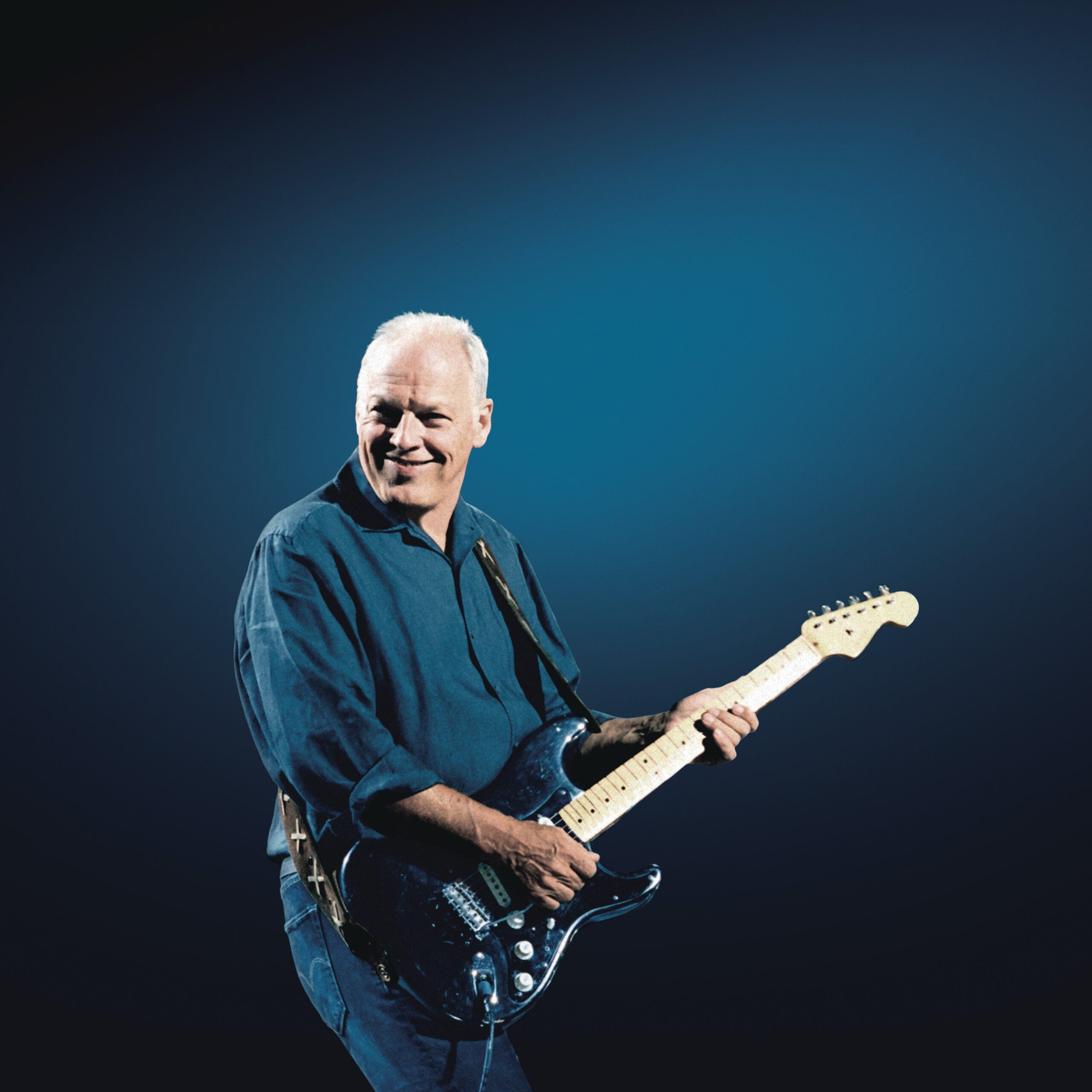
The honest answer is that worth is whatever someone is willing to pay. But in the case of the Black Strat, there’s something deeper at work. This instrument didn’t just accompany great art — it was the medium through which that art was made. It’s the difference between owning a brush that a painter once held and owning the brush that painted the Sistine Chapel ceiling.
The Dark Side of the Moon has sold over 45 million copies worldwide. It spent 937 weeks on the Billboard 200. For fourteen consecutive years, it never left the chart. The album reshaped what popular music could be, and the guitar that made its most iconic sounds just sold for less than a mid-range Manhattan apartment.
Put that way, $14.55 million sounds almost like a bargain.