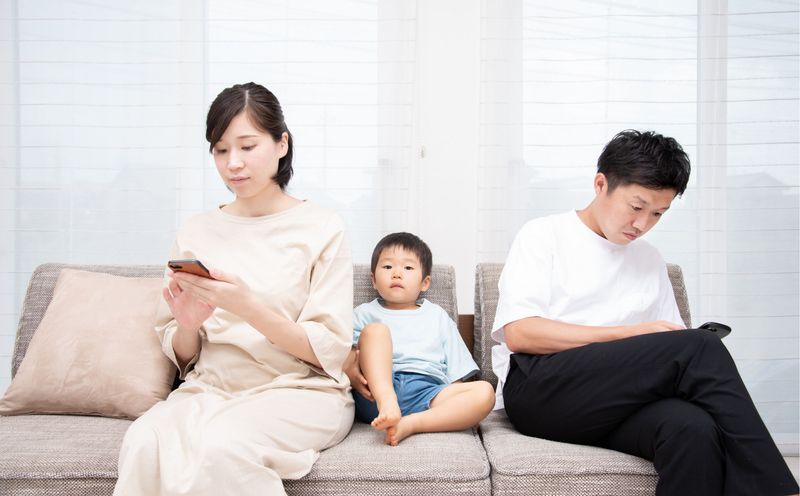
Your partner comes home every night, eats at the same table, and sleeps down the hall — yet somehow you are the only one your children turn to for everything. That gap between being physically present and actually being there for your kids is something a lot of mothers carry quietly, wondering if they are imagining it or making too big a deal of it. You are not imagining it, and your concern deserves a clear, honest look at what is actually happening in your home.
Home Is Not the Same as Available

Plenty of fathers sleep under the same roof as their children every single night and still miss most of what matters to those kids during the day. Being in the building is not the same as being available, and you have probably felt that distinction in your bones even if nobody around you has named it clearly yet.
What child-development guidance actually focuses on is something much more specific than proximity. Serve-and-return research from the Harvard Center on the Developing Child describes the back-and-forth exchanges between a caregiver and a child as the foundation of healthy development: noticing a signal, responding to it, and following the child’s lead. A father can be ten feet away and completely absent from that process.
That does not automatically make him neglectful in a legal or clinical sense. Whether a pattern rises to neglect depends on how often it happens, how long it has gone on, what caregiving context surrounds the child, and what effect it is actually having. Presence alone is not proof of harm, and absence of presence is not automatically proof of harm either.
A systematic review of longitudinal studies on father involvement found that direct engagement, not simply living in the household, is the form of involvement most consistently linked to positive child outcomes. That is a meaningful distinction, and it is the one worth holding onto.
You are not wrong to feel the weight of this. The loneliness of watching your children reach for their father and come back empty-handed is real. The starting point is not judging his intent but watching what actually happens when your child tries to get his attention, asks him a question, or needs comfort. That pattern, observed over time, tells you far more than any single evening does.
Responsive Fatherhood Shows Up in Small Exchanges

Emotional availability is not an abstract quality. You can see it, or notice its absence, in very ordinary moments throughout the day.
A responsive father makes eye contact when his child is talking to him. He answers questions instead of deflecting them. When his child is upset, he acknowledges the feeling rather than minimizing it or leaving the room. He follows what his child is interested in, whether that is a bug on the sidewalk or a story about what happened at lunch.
He offers comfort when the child is scared or hurt. These moments are small individually, but they add up into something the child can feel and rely on.
This is what the serve-and-return concept describes in practical terms. When a child reaches out with a look, a sound, a question, or a gesture and a caregiver notices and responds, that exchange supports language development, emotional regulation, and the child’s sense of being seen. Repeated missed exchanges, where the reach goes unanswered, are what researchers flag as a concern. Not one missed moment, but a consistent pattern of them.
A systematic review of father-child play interactions and their impact on child development found associations between engaged father-child interaction and children’s social and emotional outcomes. But it is worth being clear: the research does not reduce fatherhood to play. Communication, caregiving, emotional support, and shared responsibility all count.
A father who takes a child to a medical appointment and actually listens during it is being present. A father who handles bedtime and stays for the conversation that tends to happen after the lights go out is being present. Direct engagement, in whatever form it takes, is what child-development guidance points to as meaningful. Living in the same house, by itself, does not check that box.
Your Child’s Pattern Tells You More Than One Difficult Evening

One hard night does not tell you much. A child can be cranky because of a bad day at school, a disrupted sleep schedule, a growth spurt, or any number of things that have nothing to do with their father’s availability. The place to look is the pattern across weeks and months, not the worst Tuesday of a stressful month.
Signs that may be worth paying closer attention to include a child who has stopped trying to get their father’s attention after many ignored attempts, who has started withdrawing from the family in general, or who seems persistently sad, anxious, or irritable in ways that feel new or intensifying. Changes in sleep or appetite, slipping grades, pulling away from friends, or losing interest in things they used to love can all be worth noting. CDC guidance on children’s mental health notes that these kinds of changes, when they persist, are worth discussing with a professional.
The critical word is persistent. Children’s behavior can reflect temperament, developmental stage, school stress, parental mental health, family conflict, medical conditions, or neurodevelopmental differences. Research on parental depression and child outcomes makes clear that children’s functioning is shaped by multiple overlapping factors, not a single cause. Jumping straight to the conclusion that the father caused a specific behavior is not supported and is not fair to you, to him, or to your child.
What you can do is keep a mental note of what you observe over time and bring it to your child’s pediatrician if the changes are persistent or starting to interfere with daily life. Early professional support for children’s mental health is most effective when it starts before difficulties become entrenched. A pediatrician can help you tell the difference between ordinary developmental behavior and something that warrants a closer look.
You Should Not Carry the Connection Alone

There is a particular kind of exhaustion that comes from being the only one who notices. You are the one who tracks what your child is feeling, explains why dad seemed distracted, smooths over the hurt when a bid for attention goes unacknowledged, and handles every routine from school pickups to bedtime to doctor appointments. That is not just parenting. That is carrying someone else’s share of the relationship too, and it is genuinely wearing.
When you decide to address this with your partner, describing what you actually observe is more useful than labeling his character. “You are home, but our child often cannot get your attention when she tries” is specific and factual. It names a behavior and its impact without turning into a character verdict. Calling him checked-out, uncaring, or absent as a person tends to trigger defensiveness and close the conversation before it gets anywhere productive.
A conversation structure that tends to hold up: name the specific thing you have observed, describe the impact on your child, and ask for one concrete change. “I’ve noticed that when she tries to show you something after dinner, you are usually on your phone and she gives up. I’d like you to put the phone down for the first thirty minutes after you get home and actually be with her.” That is a request, not a diagnosis.
The American Academy of Pediatrics recommends consistent, specific family communication as a foundation for healthy household functioning. One conversation, though, cannot carry the whole weight. If the response is dismissal, irritation, or a brief change followed by a return to the old pattern, that tells you something about what the next step needs to be. The goal is for him to take meaningful ownership, not for you to manage his relationship with your child on his behalf indefinitely.
Connection Becomes Visible Through Shared Routines
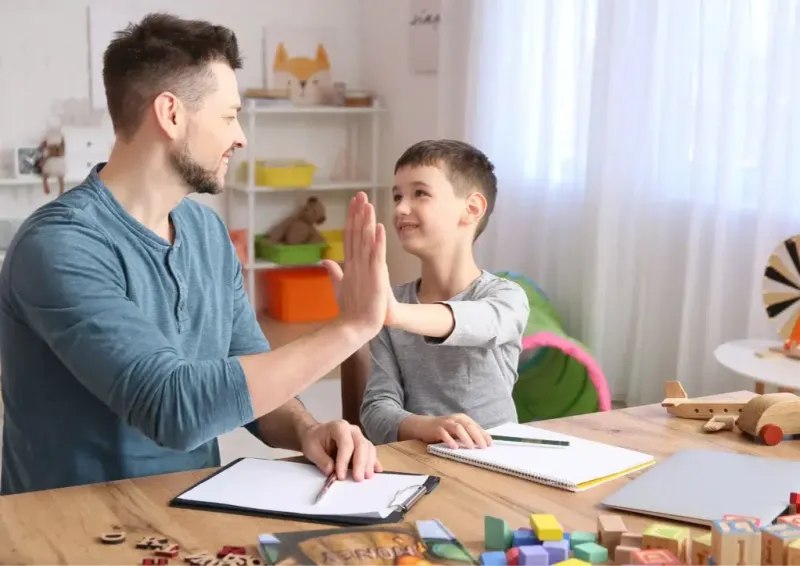
Emotional availability has to show up somewhere concrete to mean anything. Saying “I’ll try to be more present” without a specific change attached to it tends to dissolve within a week. What actually builds connection over time is predictable, repeatable involvement in the routines that already structure your child’s day.
Some practical examples worth suggesting: undistracted one-on-one time where the child picks the activity and the phone stays in another room. Bedtime handled by him, including the conversation that often opens up after the lights go out. Sitting with the child during homework, not solving it for them, but being there. Attending medical appointments and paying attention during them.
Sharing meals and asking about the child’s day with real follow-up questions instead of moving on after a single-word answer.
CDC guidance on parenting structure and routines supports consistent, predictable involvement as a foundation for children’s sense of security. Consistency matters more than any single grand gesture. A father who reliably shows up for bedtime five nights a week builds something real. One impressive Saturday followed by two weeks of absence does not.
When a connection gets missed, a direct repair matters more than pretending it did not happen. A simple “I wasn’t really with you last night and I’m sorry” followed by a concrete plan to reconnect teaches the child something valuable: that relationships can be repaired honestly.
Two things are worth separating out here: emotional responsiveness, which is about how he responds to the child’s feelings and bids for attention, and practical responsibility, which is about whether he carries a real share of caregiving tasks. A father can be warm and emotionally engaged while still leaving all the logistics to you. Both dimensions matter, and the goal is not perfection in either one but genuine, sustained participation in both. That responsibility belongs to him, not to you to manage for him.
A Possible Cause May Explain the Distance Without Excusing It

Sometimes emotional distance has a source that has nothing to do with how much a father cares about his children. Depression, anxiety, chronic stress, and burnout can all reduce a person’s capacity to show up, respond, and engage, not because they have decided not to, but because they are genuinely running on empty.
A prospective population study by Ramchandani et al. on paternal depression in the postnatal period found associations between fathers’ mental-health difficulties and child-development outcomes. More recently, a systematic review and meta-analysis on paternal perinatal depression, anxiety, and stress found similar patterns across multiple studies. These are associations in research populations, not proof that any particular father’s distance has a single identifiable cause.
A systematic review on parental burnout found that sustained caregiving and work demands can lead to a specific kind of exhaustion that affects parents’ emotional availability. Burnout is not the same as depression, but both can look like disengagement from the outside.
If you have noticed that your partner seems genuinely depleted, withdrawn from you as well as from the children, or struggling in ways that feel bigger than a bad mood, it may be worth gently naming what you are observing and suggesting he speak with his doctor. That is not diagnosing him. That is caring about the person and the family at the same time.
A possible explanation, though, is not an excuse for the impact on your children. The effect on them is real regardless of the cause. Getting him appropriate help, if he is willing, can be part of the path forward, but it does not transfer the responsibility of addressing the pattern from him to you. Your job is not to become his therapist or to manage his recovery on top of everything else you are already carrying.
When Emotional Distance Includes Control, Safety Comes First

Emotional distance and coercive control are not the same thing, and that distinction matters enormously for what you should do next. A father who is disengaged, checked out, or emotionally unavailable is not automatically an abusive partner. Many men who struggle to connect with their children are not dangerous, and the conversation and practical steps described in earlier sections may genuinely help.
The situation is different when disengagement is accompanied by patterns of control. CDC guidance on intimate partner violence describes psychological aggression as communication or behavior intended to harm or control a partner. That includes threats, intimidation, isolation from friends or family, monitoring movements or finances, and gaslighting, which means being told repeatedly that what you are experiencing is not real or that you are overreacting.
The National Domestic Violence Hotline’s resource on emotional abuse identifies withholding affection as a tool of control when it is used deliberately to punish or manipulate. The line between a man who is emotionally unavailable and one who is using emotional withdrawal as a form of power over you and the children is not always obvious from the inside, and that is exactly why outside support matters.
If you recognize patterns of control, threats, or intimidation in your relationship, please do not stage a confrontation, demand joint counseling, or announce plans in a way that could increase your risk. CDC research on risk factors for intimate partner violence supports prioritizing safety planning before any other step when control or harm is part of the picture.
The National Domestic Violence Hotline offers confidential, 24/7 support by phone at 1-800-799-7233, by chat at thehotline.org, and through their safety planning tool. If you are in immediate danger, call 911. Your safety and your children’s safety come before any relationship repair conversation.
Your Child Needs Reliable Connection, Not a Perfect Family Picture

Your child’s future is not written by one parent’s limitations. That is not a platitude. Harvard’s Center on the Developing Child emphasizes that one stable, committed, responsive relationship with a caring adult is one of the most powerful protective factors in a child’s development. You may already be that relationship for your child, and that is genuinely significant.
That does not mean the father’s pattern is unimportant or that you should pretend it is not happening. It means that your consistent presence, your responses to your child’s bids for attention, and your honesty with them when things are hard are doing real work. You can also strengthen your child’s connections with other trusted adults: a grandparent, aunt or uncle, teacher, coach, or family friend who shows up reliably can add to the network of support your child draws from.
When difficulties persist, professional support is appropriate and worth pursuing without waiting to see if things improve on their own. Early mental health support for children is most effective before problems become entrenched. A pediatrician, family therapist, or child psychologist can help both you and your child navigate what is happening without requiring the father to participate if he is unwilling.
You do not have to resolve the father’s relationship with your children by yourself, and you do not have to make an immediate decision about the relationship to take a meaningful next step. The most useful thing you can do right now is stay responsive to your child, honest about what you observe, and open to getting support for both of you. The adults in a child’s life are responsible for the child’s experience. That responsibility belongs to both parents, and you deserve to share it.