
Finding out your partner had an affair can send your mind straight to one painful question: was she better than me? That question feels urgent, but the answer it assumes – that his choice was a ranking of your value – is one worth pushing back on. An affair says something about his decisions, not about your worth. What follows is an honest look at why that distinction matters and what you can actually do with it.
An affair is not a verdict on your worth
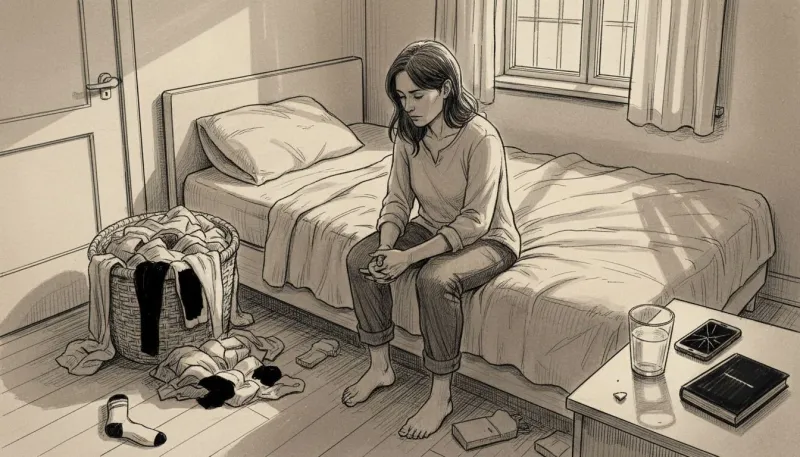
The fear that cuts deepest after an affair is usually not about him. It is the quiet, corrosive suspicion that she had something you did not – that she was prettier, more fun, less complicated, or simply more lovable. That fear is understandable, and it deserves to be taken seriously rather than brushed aside with a platitude.
Here is what the research actually supports: his affair does not, by itself, measure your attractiveness, your intelligence, your emotional value, or your adequacy as a partner. A peer-reviewed study of 495 people identified a wide range of infidelity motivations – low commitment, anger, lack of love, desire for variety, situational opportunity, and esteem enhancement among them. None of those motivations require the affair partner to be objectively superior to the person being cheated on. The affair reflects his choices, shaped by his values, his state of mind, and the circumstances around him.
That reassurance does not mean the relationship was irrelevant. It is possible that he was unhappy, that something between you two had gone quiet, or that real problems went unaddressed. Acknowledging that possibility is honest. What it does not do is make you responsible for his decision to deceive you rather than talk to you, leave, or ask for help.
An affair is conduct that requires interpretation, not a scorecard. Research on affair motivations found that the reasons people reported for their affairs were not linked to how they rated their affair partner’s desirability – meaning the act itself cannot tell you how he ranked either of you. You are not reading the results of a competition. You are living through the fallout of a choice he made.
“Easier” is a story, not a research category

The word “easier” gets used a lot in conversations about affairs. It sounds explanatory – like it names something real and settled. But when you press on it, the word turns out to be remarkably slippery.
Easier could mean she was more available – geographically, emotionally, or just in terms of timing. It could mean she asked less of him, held him to fewer standards, or offered the kind of uncomplicated validation that a long-term relationship rarely provides. It could mean she represented novelty, or that the relationship with her carried no history, no conflict, and no real accountability. In some cases it might simply mean she was there during a moment of poor judgment.
None of those possibilities are the same thing, and research does not point to a single, universal type of affair partner. Studies examining extradyadic behavior and attractiveness do not support the conclusion that affair partners are consistently less attractive, less capable, or less valuable than the person being cheated on – or more so. The existence of an affair cannot establish a ranking of either woman’s worth, desirability, or appeal.
Gender patterns in infidelity also shift depending on how researchers define the behavior and which population they study. One study of divorcing couples found no meaningful difference between men and women in self-reported affairs near the end of marriage – a reminder that broad statements about what “men” do should be held loosely rather than treated as settled fact.
When someone tells you he chose someone easier, they may be trying to protect your feelings. That impulse is kind. But “easier” is a subjective story someone told to make sense of a painful situation – not a verified psychological category or a fact about your value.
The relationship may be part of the context without making you the cause

Affairs are rarely explained by a single cause, and the research reflects that complexity. A review of infidelity causes and consequences identifies a range of contributing factors: neglect, anger, sexual dissatisfaction, low commitment, a desire for autonomy, situational opportunity, and permissive personal values. Some of those factors are about the relationship. Others are entirely about the person who chose to cheat.
Relationship dissatisfaction does appear in the research – it is a real factor for some people who report affairs. Pretending that the state of a relationship never matters would be its own kind of dishonesty. But dissatisfaction is context, not a cause that transfers responsibility onto you. Plenty of people feel unhappy in their relationships and do not cheat.
The decision to pursue an affair rather than communicate, seek counseling, or leave is a choice he made.
Research on users of an affair website found that motivations tied to anger, sexual dissatisfaction, and low commitment were associated with lower relationship quality – but autonomy-related motivations were actually associated with higher relationship quality. That finding alone is enough to show that affairs cannot be explained by a single “the relationship was broken” narrative.
There is also the question of love. A common assumption is that a man who truly loved his partner could not cheat. The research on infidelity motivations does not support that as a reliable rule. The same study of 495 participants found that people reported affairs under varied combinations of love, dissatisfaction, opportunity, and personal motives.
Love alone does not function as a behavioral guarantee.
Understanding what may have contributed to an affair can be useful. It can help a couple have an honest conversation or help you make a clearer decision about what comes next. What it should never do is become a reason to hold you responsible for his deception.
Assess his conduct instead of guessing her advantage

After an affair comes to light, it is almost instinctive to turn toward the other woman. What did she look like? What did she offer? What did she do that you did not?
The mind reaches for her as if she holds the answer to why this happened.
She does not. The answers – to the extent that any exist – live in his choices, his values, and his behavior before and after the affair. Research can identify population-level associations between infidelity and factors like attachment patterns or relationship quality, but those associations do not diagnose any individual. A systematic review and meta-analysis of 17 studies found modest links between attachment insecurity and infidelity, while also making clear that relationship satisfaction, personal values, and outside influences all play a role.
A modest association across a large sample tells you very little about why one specific person made one specific choice.
Longitudinal research adds another layer of nuance. Studies of newlywed couples found that attachment anxiety in either spouse was linked to later infidelity, but findings in dating relationships did not always match those in marriages. The picture is complicated, and it does not resolve into a clean explanation for any single case.
What you can actually observe is his conduct. Does he acknowledge what he did without minimizing it? Does he accept responsibility rather than redirect blame onto you or the state of the relationship? Has he ended the affair completely and transparently?
Is he willing to answer your questions honestly, even when the answers are uncomfortable?
Those questions are not a formula, and the answers do not guarantee a particular outcome. But they give you something real to work with – concrete behavior rather than speculation about what she had that you lacked. Infidelity research consistently points back to the unfaithful person’s choices as the central factor. That is where your attention is most useful.
Comparison cannot answer why he chose deception
At some point, many women who have been cheated on find themselves searching the other woman’s social media, replaying what they know about her appearance, her personality, her life. The urge makes complete sense. When something this painful happens without a clear explanation, the mind goes looking for one.
The problem is that the comparison cannot give you what you are looking for. Research on extradyadic behavior and attractiveness does not support the conclusion that affair partners are consistently more attractive, more sexually appealing, or more desirable than the betrayed partner. Physical appearance, sexual chemistry, and perceived desirability are factors researchers have examined, and they do not produce a clean answer about why a specific person chose to cheat.
More than that, turning his decision into a measure of your appearance or personality quietly shifts the question in the wrong direction. The question is not whether you were attractive enough, easygoing enough, or exciting enough. The question is why he chose deception rather than honesty when something was wrong.
You did not need to be perfect to deserve faithfulness. You did not need to be the most exciting person in the room, the most accommodating partner, or the least complicated woman he had ever met. Honesty and commitment are not rewards for being exceptional – they are things a person either chooses to offer or chooses not to. That choice belonged entirely to him.
Spending energy measuring yourself against her is painful, and it tends to keep the focus on a question that has no useful answer. What she looked like, what she offered, or what she was willing to accept from him tells you almost nothing about your own value.
Look for accountability, not a perfect explanation
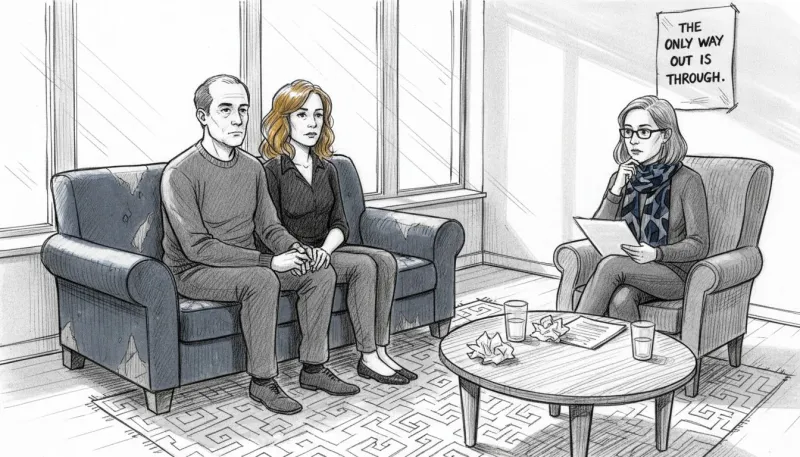
There is a particular kind of exhaustion that comes from trying to understand an affair fully – from wanting a complete, logical explanation that accounts for everything he did and makes it somehow make sense. That explanation rarely arrives, and waiting for it can keep you stuck.
A more useful place to put your energy is accountability – his, and the practical question of what he does next. A reasonable set of things to watch for includes whether he has ended the affair completely, whether he tells the truth when you ask direct questions, whether he is willing to answer those questions without becoming defensive or turning the conversation back onto your behavior, and whether he changes the patterns – the late nights, the secrecy, the emotional distance – that may have accompanied the affair.
These are not a scientifically validated checklist, and none of them guarantee that trust will be restored or that the relationship will recover. A randomized controlled trial of couples therapy after a disclosed affair found improvements in some anxiety and depression outcomes, but did not find sufficient improvement in relationship satisfaction for both partners. That is an honest picture: repair is possible for some couples, but it is not automatic, and it is not promised by any particular set of steps.
Before making any major decision about the relationship, seeking individual support – a therapist, a counselor, or a trusted professional – gives you space to process what happened without pressure. You do not have to decide immediately whether to stay, leave, or wait. Those are separate questions, and none of them is morally superior to the others.
Couples therapy can be a meaningful option when both people are genuinely willing to participate, the affair has ended, and the environment is emotionally safe. It is not a requirement, and it is not the only path toward clarity. Your first obligation is to yourself – your own understanding, your own stability, and your own next step.
Safety comes before saving the relationship

Most conversations about affairs focus on what happened emotionally and what comes next relationally. Before any of that, there is a more fundamental question that deserves a direct answer: are you safe?
If your partner has responded to the affair coming to light with intimidation, threats, controlling behavior, or any form of physical or sexual coercion, the conversation about repair needs to stop. Those behaviors change what the right next step looks like entirely. The National Domestic Violence Hotline is clear that abuse is never the victim’s fault and that both emotional and physical safety planning are necessary when coercion or abuse is present.
Couples therapy, in particular, is not appropriate when one partner is using threats, surveillance, stalking, or coercive control. Joint sessions can give an abusive partner additional tools for manipulation and can make it harder, not easier, for the person being harmed to speak honestly. CDC guidance on intimate partner violence prevention emphasizes victim-centered services and support for survivors, not couples-repair frameworks, when safety is at risk.
If you are uncertain whether what you are experiencing crosses into coercive or abusive territory, that uncertainty itself is worth taking seriously. The Hotline’s safety planning resource offers practical guidance for assessing your situation and making a plan that puts your physical and emotional wellbeing first.
Reconciliation is not the expected outcome of an affair. Leaving, waiting, or rebuilding are all valid paths, and none of them requires you to put yourself at risk to get there. Safety is not a condition you earn by handling things the right way – it is something you are entitled to regardless of what you decide about the relationship.
You were never required to compete for faithful love

Faithful love is not a prize awarded to the most desirable, the least demanding, or the most accommodating partner. It is something a person either chooses to offer honestly or does not. His affair was not evidence that you failed to earn it.
Research on infidelity motivations consistently shows that affairs arise from a combination of personal choices, relationship circumstances, individual values, and situational factors. That complexity does not erase his responsibility – it makes it harder to reduce the affair to a simple verdict about your worth, which is exactly the point. You are not the conclusion of his behavior.
Relationship context can be real and still leave the decision fully in his hands. You can acknowledge that things between you were imperfect without accepting that his deception was your fault. Those two things can both be true at the same time.
What belongs to you now is the ability to assess what he actually does, protect your own safety, seek support from people equipped to give it, and choose the path that best respects your dignity. Recovery after betrayal looks different for every couple, and there is no single right answer about what comes next. The only measure that matters here is whether the path you choose honors who you are – not whether it matches what he deserves.