
Handling everything yourself can look like strength from the outside, and sometimes it genuinely is. But for some women, doing it all alone is less a choice and more a habit built from years of asking and being met with silence, dismissal, or half-hearted follow-through. That gap between needing someone and learning not to bother is quiet, invisible, and exhausting. This article looks honestly at what self-reliance can cost, what a partner’s responsiveness actually means for a relationship, and how to tell the difference between independence you chose and independence you were left with.
Her competence may be real—and still have a cost

Calling a self-reliant woman “not strong” misses the point entirely. Competence, independence, and the ability to manage a household, a career, and a family without leaning on others can reflect genuine capability. For some women, handling things alone is a deliberate preference. For others, it is shaped by financial necessity, cultural expectations, a caregiving history that required early self-sufficiency, disability-related experience, or simply a private personality that finds asking uncomfortable.
None of those reasons make her weak, and none of them require a wound to explain.
And yet. Strength and cost can exist in the same body at the same time. A woman can be genuinely capable and also quietly tired of being the only one who notices what needs doing, who follows through, who holds the whole household in her head. That tiredness is worth paying attention to, not because it proves something went wrong, but because it points toward what she may actually need.
One place researchers have looked is the quality of perceived partner responsiveness, which describes a pattern of feeling understood, cared for, validated, and supported by a partner over time. Research comparing U.S. and Japanese couples found that lower perceived responsiveness was associated with lower relationship satisfaction, while higher responsiveness was linked to greater intimacy and well-being. This is not about a partner reading her mind. Responsiveness, as researchers define it, involves caring engagement after a need is expressed, not magical intuition before she speaks.
For some people, repeated experiences of feeling misunderstood, uncared for, or unsupported by a partner may gradually make depending on that person feel pointless. That is one possible explanation for extreme self-reliance, not the only one, and not a diagnosis. Recognizing it is simply a starting place for asking an honest question: is this independence something she chose, or something she was quietly trained into?
When relying on others starts to feel futile

There is a difference between choosing not to ask and no longer believing that asking will work. The first is a preference. The second is something closer to an expectation that forms quietly over time, shaped by repeated experiences of reaching out and finding that nothing changed, that the follow-through never came, or that the ask itself somehow became a problem.
Psychological research on stress and perceived control offers a limited but useful frame here. A 2016 review of learned helplessness research by Maier and Seligman found that after repeated exposure to situations that feel uncontrollable, some people reduce their efforts to change those situations. The brain begins to treat the outcome as fixed. But this theory describes a specific response to uncontrollable stress, not a personality type, not a synonym for competence, and not an explanation for every woman who overfunctions or rarely asks for help.
Using the term loosely flattens what is actually a nuanced and context-dependent process.
What the research does not show is a direct, proven pathway from an unresponsive partner to a woman becoming self-reliant. The connection is plausible and worth considering, but the evidence is largely correlational. Personality, family history, financial circumstances, work demands, cultural background, and personal values all shape how someone relates to dependence and support. A single explanation rarely covers the full picture.
What some women do describe is something simpler and harder to name: a felt sense that asking is not worth the effort. That “no one would come” is not necessarily a literal historical record of every request being ignored. It may be an emotional expectation, a posture the nervous system adopted after enough disappointments to make hoping feel risky. Validating that feeling does not require proving that every prior ask was refused.
The feeling itself is real, and it matters, even when the full story is more complicated than any single cause can capture.
The invisible work behind looking capable

From the outside, a woman who manages everything can look like she has it together. What that picture leaves out is the constant background hum of cognitive work that never stops: remembering the pediatrician appointment, anticipating that the school permission slip is due Friday, monitoring the household supplies, coordinating who picks up whom and when, and mentally delegating tasks to people who may or may not follow through without a reminder. That work is called the mental load, or cognitive household labor, and it is largely invisible precisely because it happens before the visible tasks even begin.
An observational study of 322 mothers of young children found that women reported carrying a disproportionate share of this cognitive household labor. Greater cognitive workload was associated with more stress, burnout, depressive symptoms, poorer mental health, and lower relationship functioning. Because the study was observational, it shows associations rather than proof that unequal cognitive labor directly caused those outcomes. Other factors, including individual mental health history, financial stress, relationship dynamics, and employment, may also contribute.
Still, the pattern is consistent enough to take seriously.
The transition to parenthood is a particularly revealing moment. A longitudinal study of new parents found that lower ratings of responsiveness, both given and received between partners, predicted declines in relationship satisfaction during the first two years after a baby arrived, a period researchers describe as chronically stressful. These findings apply to the couples studied and should not be generalized to every family or household structure. But for women who noticed a shift in how supported they felt after a major transition, the research reflects something real.
Appearing capable while quietly carrying an unequal share of the household’s cognitive weight is not the same as thriving. Recognizing that difference is not a complaint. It is an honest accounting of what is actually being asked of one person.
Look at the pattern after she asks
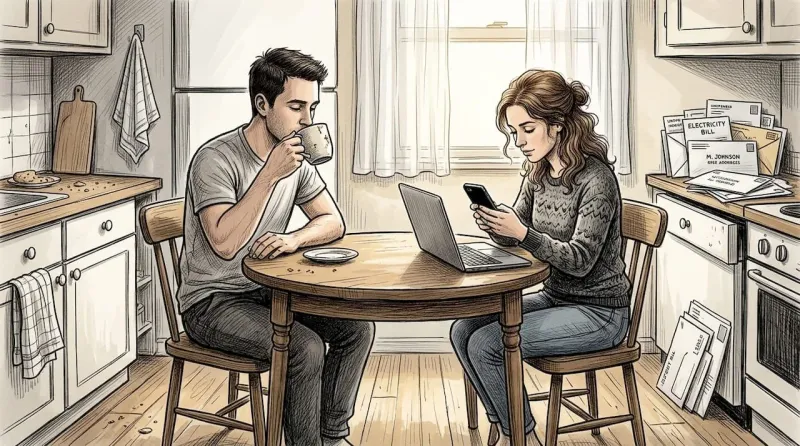
One honest question worth sitting with: when she has asked for help, clearly and directly, what happened next? Not once, because one moment rarely tells the full story. A partner who is temporarily overwhelmed by a work deadline, grieving a loss, or managing a health issue may be genuinely less available without that absence reflecting the whole relationship. Illness, acute stress, and difficult seasons can limit anyone’s capacity to show up the way they normally would.
The more telling question is about the pattern over time. Does a clearly expressed need get met with curiosity and follow-through, or with dismissal, defensiveness, blame, or a promise that quietly disappears? Research on perceived partner responsiveness focuses on exactly this kind of sustained relational experience, not a single good or bad moment, but the accumulated sense of whether a partner understands, cares about, and responds to what matters to her.
Healthy responsiveness does not require mind-reading. A partner who genuinely cares does not need to anticipate every need before it is spoken; that expectation sets up both people to fail. What responsiveness does require is respectful engagement once a need is expressed. Listening without minimizing.
Following through without needing a second and third reminder. Acknowledging when they fell short instead of turning the conversation into a grievance about being asked.
A useful way to sort through this is to separate three different situations. The first is a need that was never clearly communicated, where the partner may simply not have known. The second is a request met by a temporary limitation, where the partner was genuinely stretched thin. The third is a repeated pattern: needs expressed clearly, heard without follow-through, met with contempt or avoidance, or consistently left to one person to manage.
A 10-year longitudinal study found that perceived partner responsiveness predicted increases in eudaimonic well-being over time, which underscores why this pattern, not any single moment, carries so much weight in a relationship’s health.
Turn vague help into shared ownership

Asking for help and transferring ownership are not the same thing, and the difference matters more than most people realize. When she notices a problem, mentally organizes the solution, assigns the task, explains the steps, and then checks whether it was done, she has managed the entire process herself while technically “getting help” with the execution. That is not shared responsibility. That is supervision with extra steps.
Shared ownership means a partner takes full charge of an area: noticing when something needs attention, planning how to address it, scheduling or coordinating what is required, and completing it without a reminder. The mental work transfers along with the physical task. Research on cognitive household labor makes clear that the planning and anticipating components carry significant weight in overall workload, not just the visible doing. Shifting only the doing while leaving the noticing and managing in one person’s hands does not meaningfully reduce the load.
Before a conversation about this can happen usefully, a few reflective questions can help clarify what she actually needs. What specifically feels unmanageable right now? Has she named it directly, or has she hoped a partner would notice on their own? When she has asked before, what happened?
Did the partner engage with curiosity and make a genuine effort, or did the agreement dissolve within a week?
These prompts are practical starting points, not a test of the relationship or a clinically validated method. Pilot research on behavioral interventions targeting household labor suggests that structured approaches to redistributing cognitive and physical tasks may be useful, but this is early-stage work and should not be treated as a guaranteed solution. The goal of a conversation about ownership is not to assign blame but to replace a vague request for help with a specific, sustainable agreement about who is responsible for what, from start to finish, without a manager in the middle.
Put safety before communication

Before any conversation about asking for help or redistributing household responsibility, one question needs to come first: is it safe to have that conversation? For many women reading this, the answer is yes, even if the relationship is imperfect, unequal, or frustrating. But for some, the answer is more complicated, and those women deserve a direct response, not advice that was written for a different situation.
Certain patterns in a relationship change what kind of guidance applies. Control over money, transportation, housing, communication, health care, or contact with friends and family is one set of warning signs. Threats, intimidation, humiliation, monitoring of devices or movements, retaliation when boundaries are set, and punishment for expressing needs are others. The National Domestic Violence Hotline describes emotional abuse as a pattern that can include these behaviors, and distinguishes it from the ordinary friction and inequality that can exist in a struggling but non-abusive relationship.
Unequal chores and emotional exhaustion are real problems, but they are not the same as coercive control, even though they can sometimes exist alongside it.
When coercion or abuse may be present, the advice to “just ask for help,” have an honest confrontation, document what is happening, or leave immediately is not safe or appropriate for everyone. People in these situations may face financial dependence, children, immigration concerns, housing insecurity, disability, pets, or the real possibility of retaliation. Safety planning needs to be individualized, not generic.
The Hotline’s safety planning guidance notes that internet use may be monitored and recommends taking steps to protect browsing history. Couples therapy is also not recommended when coercive control is present, as it can create additional risk. For confidential, individualized support, the National Domestic Violence Hotline is available 24 hours a day by phone, text, and online chat, and advocates are trained to help each person think through her own specific situation without pressure or a predetermined plan.
Let support expand her choices

A partner is not the only possible source of support, and for some women, he may not be the most reliable one right now. Trusted friends, family members, therapists, physicians, support groups, and community services can all offer something real, whether that is practical help, emotional presence, information, or simply a space where she does not have to manage the conversation alone.
Reaching out is not always straightforward. A systematic review of barriers to formal help-seeking among adult survivors of intimate partner violence identified fear, mistrust, practical constraints, isolation, and concerns about safety or consequences as significant obstacles. These barriers are real and deserve to be named rather than minimized. The decision to seek support is personal, and the path toward it looks different for every woman depending on her circumstances, relationships, and resources.
Research on help-seeking behavior among survivors of intimate partner violence emphasizes that the process is rarely linear and that what a woman needs from support can change over time. Autonomy matters throughout. A good supporter, whether a friend, family member, or advocate, asks what kind of help she wants rather than deciding what she needs and acting on it unilaterally. The Hotline’s guidance for supporters specifically cautions against taking over and notes that contacting authorities without a safety plan in place may create additional risk in some situations.
Accepting support is not a concession that she cannot manage. It is a way to gain more information, more options, and more connection, all of which expand what is possible for her. Competence and help are not opposites. The strongest position is often the one with the most resources behind it, not the one held entirely alone.
Strength can be chosen instead of compulsory

Two things can be true at once. She may be genuinely strong, capable, and competent. And she may also have learned, through enough quiet disappointments, to perform that strength because depending on someone felt unreliable, disappointing, or unsafe. Those two truths do not cancel each other out.
They simply point toward a question worth sitting with: is this self-reliance something she chose, or something that chose her by default?
Chosen independence feels different from compulsory independence. One comes with a sense of agency. The other comes with a low-grade exhaustion that is hard to name because it looks, from the outside, exactly like strength. Research on partner responsiveness over a 10-year period found that feeling understood, cared for, and supported by a partner was linked to sustained well-being, which suggests that the quality of relational support matters over time, not just in acute moments of need.
No article can tell her what her relationship means or what she should do next. What it can offer is a few honest questions to carry forward: When she expresses a need clearly, does it receive respectful follow-through? Does support feel available, or does it always come with conditions, delays, or a cost? And if she reached out, to a friend, a counselor, a hotline, or a trusted person in her life, what might become possible that is not possible right now?
Asking for what she needs does not erase her competence. It adds to it. The woman who can do everything alone and also knows when and how to ask for support is not weaker than the one who goes it alone. She simply has more options.