
There’s a moment that’s hard to describe but easy to recognize: you stop trying to explain how you feel, not because you’ve given up on yourself, but because the words keep going nowhere. You’ve said the same thing in a dozen different ways, and still you walk away feeling more alone than before you spoke. That silence isn’t coldness – it’s what happens when someone runs out of places to put her truth.
When explaining yourself still leaves you unseen

You know the feeling. You’ve chosen your words carefully, kept your voice steady, explained the same hurt or need for what feels like the hundredth time – and somehow the conversation ends with you feeling further from understood than when you started. That gap between speaking and being heard is one of the quieter kinds of loneliness, and it can settle into a relationship without either person quite naming it.
Feeling understood, cared for, and appreciated by a romantic partner isn’t a luxury. Research on perceived partner responsiveness consistently links those feelings to stronger relationship quality, greater intimacy, and better individual well-being. When that sense of being genuinely received is missing, it doesn’t just make conversations harder – it can quietly erode the foundation of the whole relationship.
Conflict by itself isn’t the real threat. Disagreements happen in every relationship, and they don’t automatically cause lasting damage. What matters more is whether each person feels that her thoughts, feelings, and perspective are actually landing. Across seven studies, conflict was more damaging to relationship satisfaction when people did not feel understood by their partners – not simply because conflict occurred.
So when you go quiet after one too many conversations that led nowhere, that silence is worth paying attention to. It may be a signal that something in the communication between you has broken down. Still, silence alone can’t tell you – or anyone else – whether your partner was deliberately dismissing you, struggling with his own limitations, or somewhere in between. The meaning of that quiet moment depends on a lot more than the moment itself.
A recognizable demand-withdraw pattern

Most people in this situation can describe the cycle without being given a name for it. One person brings up a problem, asks for a conversation, or pushes for some kind of acknowledgment. The other gets quiet, changes the subject, becomes defensive, or simply leaves the room. The first person tries harder.
The second pulls back further. Round and round it goes.
Researchers call this the demand-withdraw pattern, and it shows up across a wide range of relationships. A meta-analysis of 74 studies involving more than 14,000 participants found a moderate association between this pattern and poorer individual, relational, and communication outcomes. That’s a meaningful signal – but an association isn’t a simple cause-and-effect story, and it doesn’t tell you exactly what’s driving the cycle in your specific relationship.
One of the harder truths about demand-withdraw is that it rarely belongs entirely to one person. The partner who pursues may escalate in ways that make the other feel cornered. The partner who withdraws may create a vacuum that makes the first feel she has no choice but to push harder. Neither of those observations assigns blame – they’re just an honest look at how these cycles tend to move.
Research shows the pattern appears across different couple types, not only in one kind of relationship or one gender configuration.
Context also shapes what the pattern means. Studies suggest that communication behaviors considered problematic in some couples may function differently depending on socioeconomic circumstances, stress, and situational pressures. That doesn’t excuse dismissiveness, but it does mean the full picture is usually more complicated than a single label captures.
What her silence might mean

Going quiet is not one thing. The woman who stops explaining herself might be protecting what’s left of her emotional energy. She might be so exhausted by repeated conversations that went nowhere that she simply has nothing left to offer the same argument. Or she might be stepping back to regulate an emotion that feels too big to speak through right now.
Those are meaningfully different experiences, even if they look the same from the outside.
Silence can also mean something harder to admit. Avoidance, disengagement, or using quiet as a way to punish a partner are real possibilities too – not comfortable ones, but honest ones. Research on the silent treatment suggests that prolonged or unexplained withdrawal generally harms psychological well-being and relationship quality, with limited benefit unless it’s followed by constructive communication. That finding doesn’t make every quiet moment harmful, but it does matter when silence stretches on without any path back.
A few questions can help clarify what your silence is actually doing. Did you tell your partner you needed space, or did you simply disappear from the conversation? Does this pause have some kind of realistic next step attached to it, even a loose one? Do you feel clearer and safer when you’re quiet, or more trapped and distressed?
Gottman Institute research distinguishes between a self-soothing break that helps regulate intense emotion and stonewalling, which shuts communication down entirely. The difference often comes down to intention and whether there’s any genuine return to the issue.
A communicated pause – one where you say something like “I need some time before I can talk about this productively” – carries a different weight than simply going cold. Neither guarantees repair, but one leaves a door open. A 2026 systematic review found limited evidence for silence as a beneficial strategy when it operates without that kind of follow-through.
A direct boundary can express self-respect

There’s a real difference between stopping an explanation and disappearing. One is a choice about what you’re willing to keep offering; the other is a retreat that leaves both people without any ground to stand on. The space between those two moves is where something like a direct boundary lives.
Over-explaining often starts as a genuine attempt to be understood. But somewhere along the way, it can become an argument for the legitimacy of your own feelings – a case you keep rebuilding because it keeps getting dismissed. The APA defines assertiveness as expressing feelings and needs directly while maintaining respect for others – not winning, not shrinking, not repeating yourself until someone finally agrees. Assertive communication can be brief. “I’ve explained what I need.
I’m not continuing this conversation while I’m being dismissed” says something real without requiring a twenty-minute defense of your emotional reality.
A boundary describes what you will do, not what you can force your partner to do. That distinction matters. Saying “I won’t keep explaining myself in a conversation where I’m being talked over” is a statement about your own behavior. It doesn’t control the outcome, and it doesn’t guarantee that your partner will suddenly listen.
Assertiveness training research supports the value of direct, specific communication as a way to express needs – but it doesn’t promise that the other person will receive those needs the way you hope.
Self-respect, in this context, is an interpretive frame, not a measurable result. Ending a repetitive explanation may feel protective, clarifying, or simply necessary. That’s real and worth honoring. Just know that the boundary is yours to hold – what your partner does with it is a separate question entirely.
Look at the pattern before reaching for a label
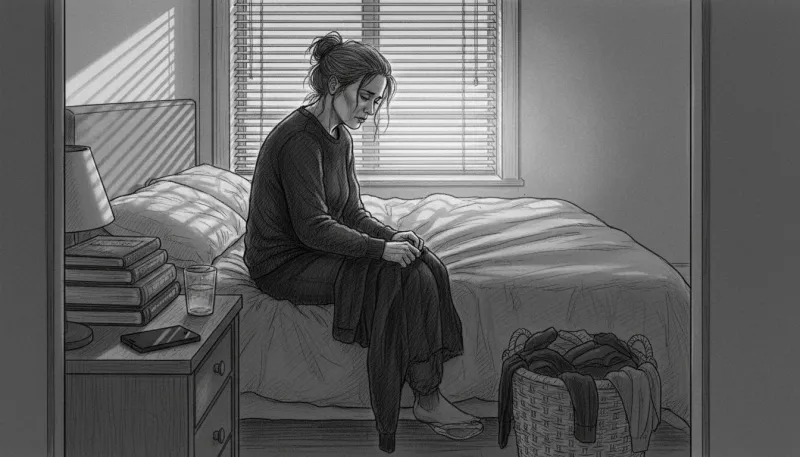
When a relationship leaves you feeling perpetually unheard, it’s natural to want a word for what’s happening. Labels can feel like relief – finally a name for something that’s been confusing and painful. But reaching too quickly for a clinical diagnosis can sometimes replace honest observation with a story that’s tidier than the truth.
Dismissiveness, defensiveness, incompatible communication styles, unresolved stress, trauma responses, and mutual withdrawal can all contribute to a dynamic where one person feels chronically unseen. None of those things automatically add up to a personality disorder. According to the American Psychiatric Association, narcissistic personality disorder requires a persistent, pervasive pattern of symptoms causing significant impairment or distress, assessed by a qualified mental health professional. Poor listening, selfishness, defensiveness, or emotional unavailability – as genuinely painful as those behaviors are – don’t establish that diagnosis on their own.
What tends to be more useful than a label is a patient look at repeated conduct. Does your partner take responsibility when something goes wrong, or does the explanation always end with you somehow at fault? When a rupture happens, is there ever a genuine attempt at repair? Personality disorder assessments consider whether patterns are pervasive, long-standing, and significantly impairing – not whether a person had a bad week or handles conflict poorly under stress.
Pay attention to how the relationship affects your sense of your own reality. Do you frequently second-guess what you felt or what actually happened? Do you feel safe saying something is wrong, or does raising a concern reliably lead to a worse outcome? Those observations, over time, will tell you more than any single label.
Safety changes the communication advice

Not every situation where a woman stops explaining herself involves a communication mismatch that therapy could address. For some women, going quiet isn’t a boundary – it’s a survival response. And when that’s the case, the advice about assertive communication, communicated pauses, and couples counseling needs to shift entirely.
There’s a meaningful difference between a partner who is defensive or avoidant and one who uses fear to maintain control. Threats, monitoring your phone or movements, isolating you from people who care about you, humiliating you privately or publicly, gaslighting you about what you experienced, withholding affection as punishment, or using coercion to get compliance – these are not communication style differences. The National Domestic Violence Hotline identifies these behaviors as forms of emotional abuse, and their presence changes what kind of support is actually appropriate.
If any of those patterns feel familiar, the goal is not to explain yourself more clearly or find better words for your feelings. The goal is safety. The Hotline offers guidance on safety planning while still living with an abusive partner, including practical steps you can take privately. Emotional safety planning addresses the specific challenges of psychological and emotional abuse, where the harm may be harder for others to see but is no less real.
One practical note: the Hotline cautions that internet use may be monitored by an abusive partner. If that’s a concern in your situation, consider accessing resources from a private device or a location where you won’t be observed. You can also reach the Hotline by calling 1-800-799-7233 or texting START to 88788. Not every difficult relationship rises to this level – but when it does, individual advocacy and safety planning come before any conversation about couples therapy.
She can stop repeating herself without disappearing

Ending the cycle of repeated explanations can be a meaningful act. After enough conversations that go nowhere, choosing not to have the same one again isn’t coldness – it’s a recognition that something in the dynamic needs to change, even if you’re not yet sure exactly what that change looks like.
The question worth sitting with is what you actually want your silence to do. A clearly communicated pause – telling your partner you need time before you can talk productively – is different from withdrawing without explanation and hoping the distance makes a point. A firm boundary about what you will and won’t continue to accept is different from disappearing in order to feel something. Neither silence nor speech automatically fixes what’s broken.
The research on demand-withdraw patterns suggests that the cycle tends to persist until something in the underlying dynamic shifts – not just in one conversation, but in how both people approach the relationship.
When both partners are genuinely willing to listen, take responsibility, and work on how they communicate, couples therapy can be a reasonable next step. Evidence-based approaches to couples therapy focus on changing destructive interaction cycles, building emotional connection, and improving how conflict gets handled. But that only works when both people can participate freely and safely – when safety is in question, individual support comes first.
You don’t have to keep arguing for the legitimacy of your feelings. And you don’t have to vanish to prove your worth. Sometimes the most honest thing you can do is stop performing the explanation and start paying attention to what the pattern, over time, is actually telling you.